The SAT Is Rigged — But Not the Way You Think
The SAT Is Rigged — But Not the Way You Think
Here is the number that should make every student without a $200/hour tutor furious:
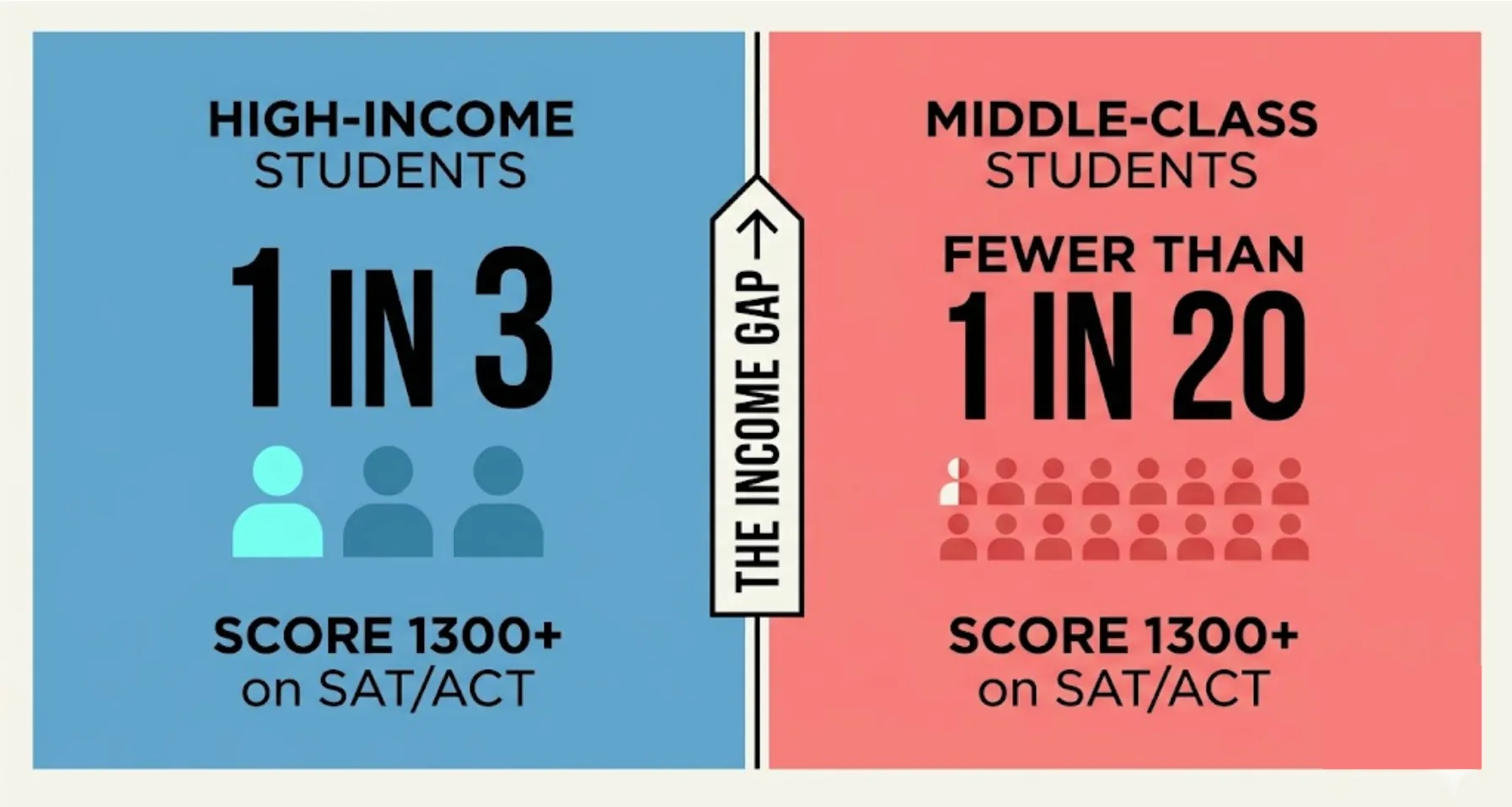
One-third of students from top-income families score 1,300 or above on the SAT. Less than 5% of their middle-class peers do.
That gap is not a fluke. It is not a measure of intelligence. It is not evidence that wealthy students study harder. It is the predictable, documented output of a $7 billion industry that has quietly transformed a test marketed as a meritocratic measure of academic potential into something that more closely resembles a measure of how much your family could afford to spend preparing for it.
This post is about that industry — how it works, who it benefits, what the data actually shows, and most importantly, what you can do about it if you're not sitting on a prep budget that would cover a semester of college tuition.
The numbers are real and they are not subtle
Start with the College Board's own data, because this isn't a fringe argument.
Students from families earning over $200,000 per year average SAT scores between 1,230 and 1,280. The national average in 2024 was 1,024. That's a gap of 200–250 points — not a rounding error, not a statistical artifact. Two hundred points is roughly the difference between a student who looks competitive at a selective university and a student who doesn't.
Research from economists at Opportunity Insights, which compared SAT and ACT scores from 2011–2015 with federal income tax records, put a precise number on this: approximately one-third of students from top-tier income families scored 1,300 or above, compared to less than 5% of their middle-class counterparts.
The Penn Wharton Budget Model found that SAT math scores — in particular — have correlations with household income roughly three times larger than high school GPA or class rank. In other words, family income predicts SAT performance far better than it predicts how a student does in their actual classes, which raises uncomfortable questions about what, exactly, the SAT is measuring.
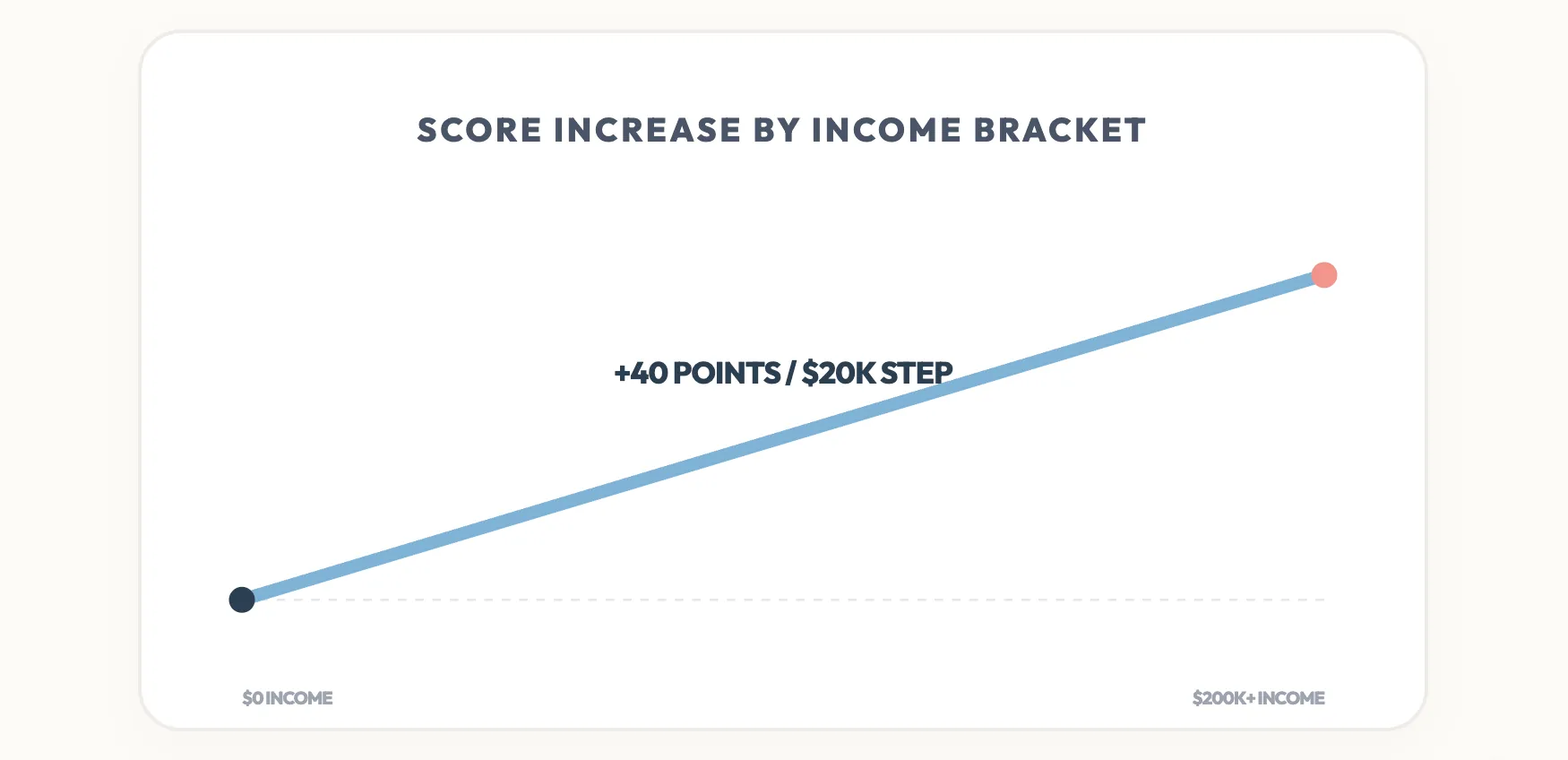
And then there's this calculation, published in 2013, which has proven remarkably durable: there was a roughly 40-point average score increase for every additional $20,000 in family income. The relationship between money and score is not random. It is nearly linear.
The industry built to monetize this gap
The SAT prep industry knows exactly what it is selling.
The global test prep market reached $119 billion in 2023 and is projected to hit nearly $200 billion by 2032. In the United States alone, K-12 test prep spending hit $1.2 billion in 2023 for standardized tests like the SAT and ACT. Princeton Review alone holds 18% market share in U.S. SAT/ACT prep — generating $450 million in revenue in 2023 from a single segment of an already enormous market.
Here is what those numbers look like at the student level.
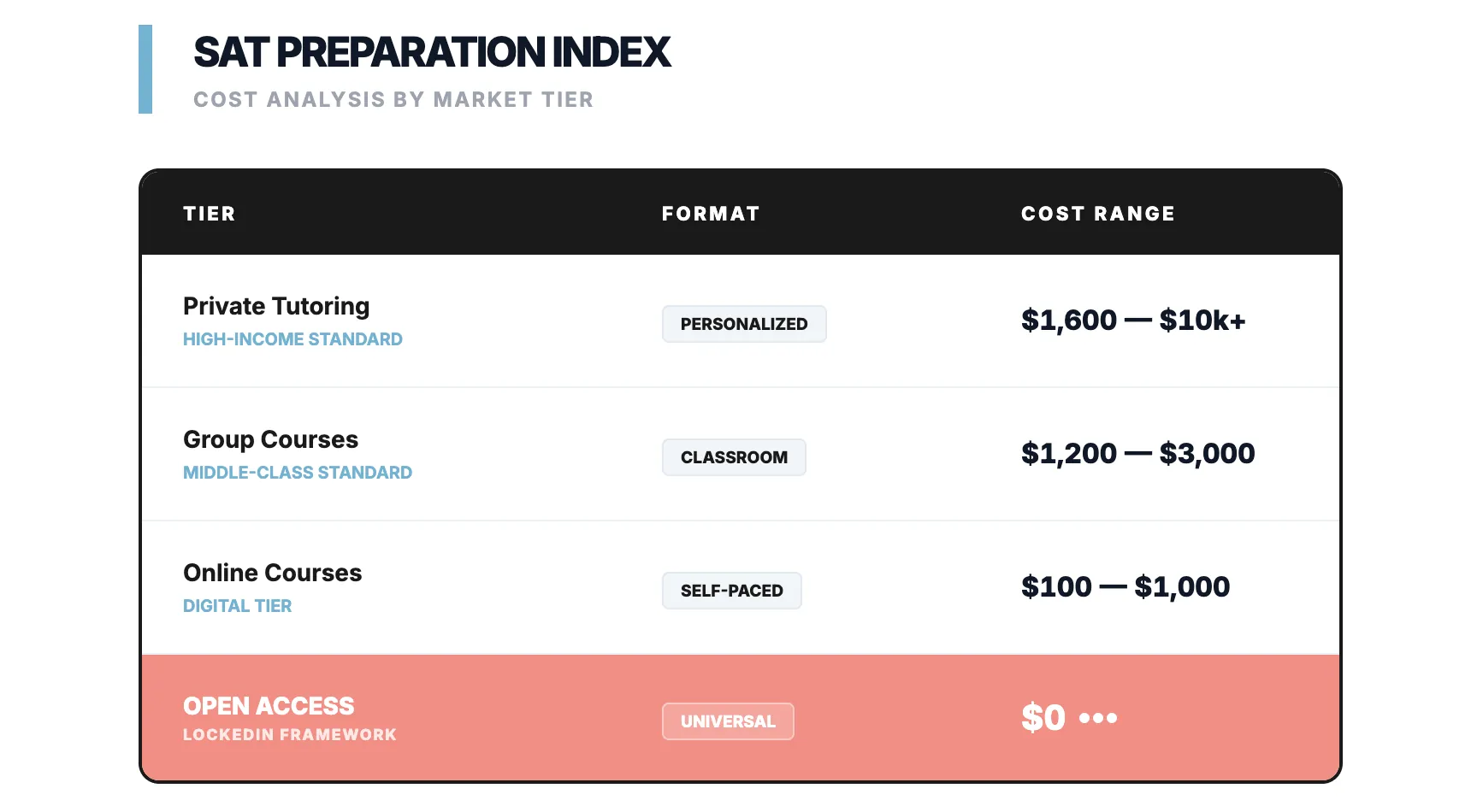
Private SAT tutoring rates in 2026 range from $100 to $200 per hour at the lower end, to $500–$1,000+ per hour for elite tutors with verified track records at top universities. Most students completing comprehensive private tutoring do 20–30 hours of instruction — meaning the total investment ranges from $1,600 to over $10,000, depending on location, tutor credentials, and package structure.
In-person group courses from major providers like Kaplan and Princeton Review charge between $1,200 and $3,000. Online courses run $100 to $1,000+. And that's before the test fees, the prep books, the practice test registration fees, and the tutoring sessions specifically for the PSAT, SAT Subject Tests, and AP exams.
72% of low-income students — those from households earning under $50,000 per year — did not use paid test prep in 2023. Not because they chose not to. Because they couldn't afford it.
Why prep spending translates so directly into scores
The uncomfortable truth underneath all of this is that the SAT prep industry works. That's the whole problem. If expensive prep courses produced no results, the industry would collapse. Students who use 20+ hours of test prep see an average 115-point SAT gain. Students using test prep services are 2.1 times more likely to score 1,400 or above.
But here's what those statistics don't tell you: the gains from paid prep are not coming from magic pedagogical techniques unavailable to self-studying students. They are coming from structure, accountability, and access to high-quality targeted practice — all things that are, in principle, replicable without spending thousands of dollars.
The National Association for College Admission Counselors noted as far back as 2009 that test-prep activities have a "minimal positive effect on both the SAT and the ACT" when compared to equivalent time spent in free self-study. What expensive courses provide is not better content. It is better structure, more accountability, and — critically — the signal to the student that this preparation is serious and worth showing up for.
There is also what researchers call "shadow education" — the educational investments wealthy families make outside of formal schooling that compound into higher test scores long before a student ever sits for the SAT. Summer enrichment programs. Academic tutoring throughout middle school. Extracurricular activities that develop disciplined study habits. Neighborhoods with high-quality schools. Access to clean, quiet study environments. Food security. None of these are captured by a prep course invoice, but all of them are upstream of test performance.
As Stanford's Sean Reardon, an endowed professor of poverty and inequality in education, explained: "Kids in disadvantaged neighborhoods end up behind the starting line even when they get to kindergarten. Schools aren't very good at undoing that damage."
The College Board's response — and why it hasn't worked
The College Board is aware of this problem. It has attempted to address it several times, with limited success.
In 2015, the College Board announced a free, official SAT prep partnership with Khan Academy. The program has genuinely helped millions of students — Khan Academy's digital SAT prep reached 10 million users by 2023, and students who used it for 20+ hours saw an average 115-point improvement. It is a meaningful intervention.
But the College Board's own research acknowledges that the Khan Academy partnership "alone will not be sufficient to fully eliminate score gaps between students from the highest and lowest socioeconomic backgrounds." The structural advantages — years of richer academic preparation, quieter study environments, lower stress from food and housing insecurity — do not disappear because a free resource became available.
In 2019, the College Board introduced the Environmental Context Dashboard (formerly called the "adversity score"), which placed student scores in the context of neighborhood affluence. It was designed to give admissions officers a way to evaluate scores relative to a student's circumstances. It was not designed to change the scores themselves — and after significant controversy and criticism, the program was quietly modified.
More recently, the widespread adoption of test-optional admissions policies seemed like it might disrupt the dynamic. But the data from the test-optional era has been mixed at best: selective universities that went test-optional saw relatively small changes in the economic diversity of their admitted classes, while the students who did submit scores — disproportionately those with access to prep resources — continued to benefit from strong results.
As of the 2025–2026 application cycle, major universities including MIT, Yale, Harvard, and most Ivy League schools have reinstated standardized test requirements. The SAT is back at the center of admissions. And the prep industry is ready.
What this means for you, right now
If you are reading this on LockedIn's blog, there is a decent chance you are a high school student or a parent of one — possibly someone who is not sitting on a $5,000 prep budget, who is trying to figure out how to close the gap without spending money they don't have.
Here is the honest answer: you can.
The score gap between wealthy and non-wealthy students is real, persistent, and structurally reinforced — but it is not insurmountable at the individual level. The research is consistent: students who self-study with structured, high-quality official resources and consistent daily practice achieve score gains comparable to those who use expensive courses. What they lack is not access to good content. What they typically lack is structure, accountability, and consistency.
Khan Academy's partnership with the College Board has produced documented 115-point average improvements for students who use it seriously. Bluebook, the official digital SAT app, is completely free and provides the only authentic simulation of the real test experience. The College Board's student question bank is free and filterable by skill and difficulty.
The gap between these students and the ones paying $500 per hour for tutoring is not content. It is the structure that keeps them showing up every single day — and the immediate, specific feedback that tells them exactly what to fix.
Why LockedIn exists
We built LockedIn because we were angry about this.
Not in a theatrical way. In the specific, practical way of people who understood that the prep industry's business model is built on a problem it has no incentive to solve — and that the tools to close the gap already existed. They just weren't packaged in a way that made daily, consistent, friction-free practice accessible to every student regardless of income.
LockedIn delivers curated SAT problems directly to your inbox, on your schedule, every day. You set the volume. The dashboard tracks your performance by domain and surfaces your weak spots automatically. The problems are designed to replicate the real test's question types, difficulty distribution, and adaptive structure.
It is completely free. It is a nonprofit. No credit card. No trial period. No freemium tier hiding the useful features behind a paywall.
The SAT prep industry is worth $7 billion. LockedIn's answer to that is zero dollars and a daily email.
We are not going to close the structural inequality that produces a 250-point average score gap between the richest and poorest American students. That requires changes in housing policy, school funding, and the economic conditions that shape a child's development long before they encounter a standardized test.
But we can make sure that every student who is serious about their score has access to the same quality of daily structured practice as the student whose parents are paying $1,000 an hour.
That's the mission. That's why we're free. That's why we'll stay free.
Start preparing for free at lockedin.study →
What you can do today — a zero-cost prep system
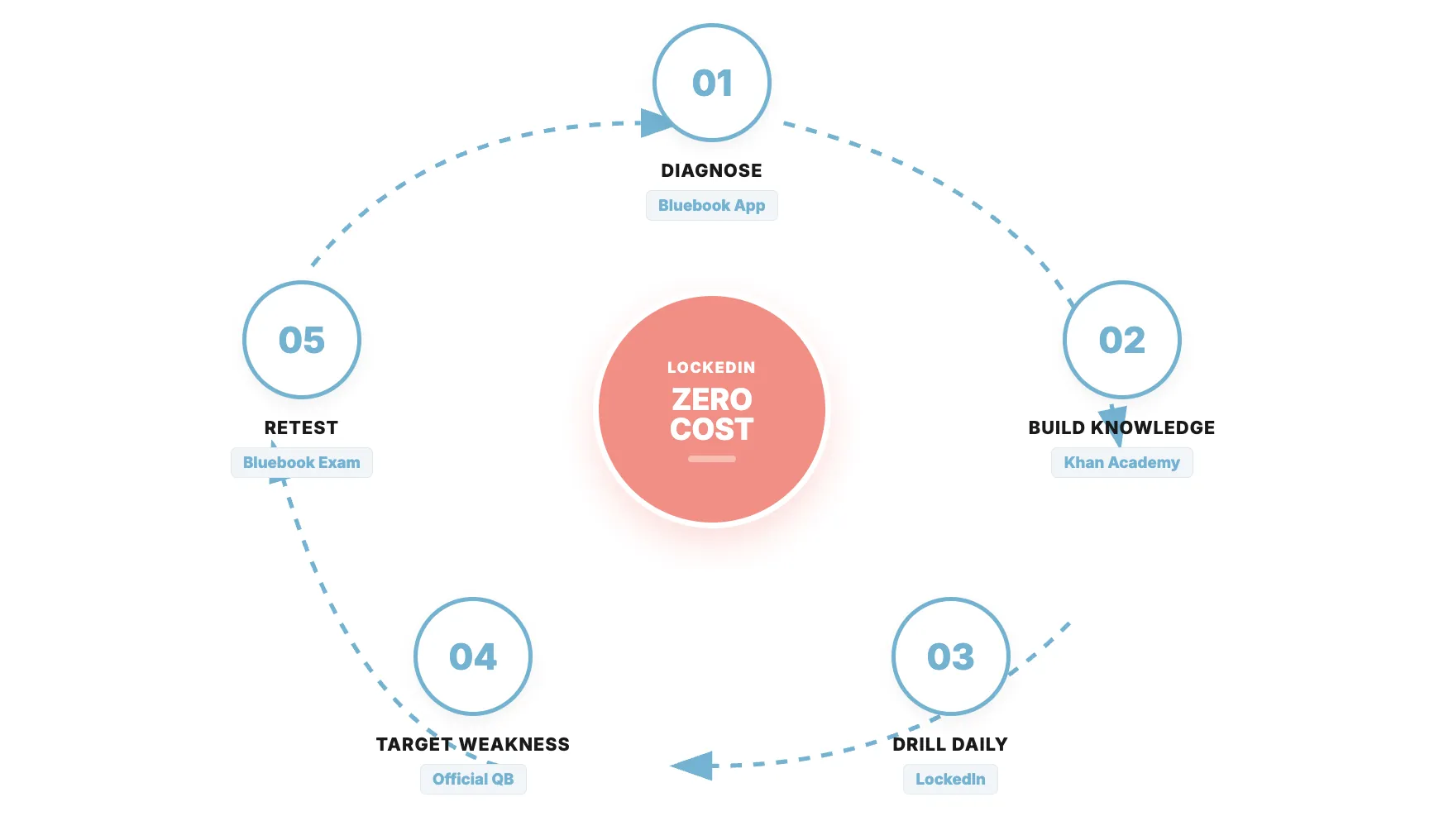
If you are preparing for the SAT without a prep budget, here is the complete free system that gives you everything the expensive courses provide except the invoice:
1. Diagnose with Bluebook Take a full-length official practice test at bluebook.collegeboard.org. This is the only tool that authentically replicates the adaptive digital SAT format. Your score report will identify exactly which domains are costing you the most points.
2. Build concept knowledge with Khan Academy Connect your College Board account at khanacademy.org/digital-sat and let it build a personalized study plan from your score report. The video lessons and practice questions cover every SAT skill at no cost.
3. Drill daily with LockedIn Subscribe at lockedin.study and set your daily problem volume. Three to five problems per day, delivered to your inbox, builds the consistency that makes the difference between a student who knows the material and a student who performs under pressure.
4. Target weak areas with the question bank Use the College Board's student question bank to drill the specific domains your Bluebook score report flagged as weaknesses. Filter by skill, filter by difficulty, and practice until those question types feel routine.
5. Retest every 3 weeks Return to Bluebook for a full-length practice test every 2–3 weeks. Track your score by domain. Adjust your focus based on what's not improving. Repeat.
This system costs nothing. It requires no tutor. It leverages every high-quality free resource available in 2026. The only thing it requires is consistency — which is why LockedIn exists.
The bottom line
The SAT is not purely a wealth test. It measures real academic skills — and those skills can be built through hard, consistent work regardless of income. But the prep industry has constructed a multi-billion-dollar architecture around the fact that structured, high-quality practice is valuable — and then priced access to that structure out of reach for the majority of students who need it most.
The data is not ambiguous. The income-score relationship is strong, documented, and persistent. One-third of wealthy students score 1,300+. Fewer than 5% of middle-class students do. That gap does not exist because of a difference in intelligence or potential. It exists because of a difference in preparation — and preparation is something that can be equalized.
Not entirely. Not overnight. But enough to matter for the student sitting down to a practice test tonight with no tutor, no course, and a genuine desire to get a score that opens doors.
That student is who LockedIn was built for.
Sources
- Opportunity Insights — Economists' comparison of SAT/ACT scores and federal income tax records (2011–2015 cohorts): opportunityinsights.org
- Penn Wharton Budget Model (2021) — Is Income Implicit in Measures of Student Ability?: budgetmodel.wharton.upenn.edu
- Dixon-Román, Everson & McArdle (2013) — Race, Poverty and SAT Scores: Modeling the Influences of Family Income on Black and White High School Students' SAT Performance. Teachers College Record, 115(6): journals.sagepub.com
- The Daily Pennsylvanian (2023) — National study reveals SAT scores as indicators of America's educational wealth disparities: thedp.com
- Georgetown University — SAT score gaps reveal deeper inequality in education, opportunity: feed.georgetown.edu
- Harvard Gazette (2023) — Wide gap in SAT/ACT test scores between wealthy, lower-income kids: news.harvard.edu
- Legacy Online School (2025) — SAT scores by family income 2025 data: legacyonlineschool.com
- BestColleges (2025) — Average SAT score and statistics by income, race, gender: bestcolleges.com
- GitNux (2026) — Global test prep industry statistics: gitnux.org
- Private Prep (2026) — Average SAT test prep cost 2026 data: privateprep.com
- The College Investor (2025) — How much does SAT prep cost on average?: thecollegeinvestor.com
- Applerouth (2019) — Wealth, the SAT, Access, and the New Adversity Score: applerouth.com
- National Association for College Admission Counselors (2009) — The impact of standardized test preparation: Meta-analysis
- BizStim (2025) — SAT prep services: a booming business amidst college admissions changes: bizstim.com
- The Fiscal Times — SAT tests: another drain on the family budget: thefiscaltimes.com
Related: Free SAT prep resources that actually work in 2026 Related: Why everything you know about studying for the SAT is wrong Related: How to study for the SAT effectively: the no-BS blueprint
LockedIn is a nonprofit SAT prep platform — free forever, built for students who are serious about their score. Get started at lockedin.study.
Enjoyed the read?
Join 10,000+ students getting elite SAT drills every morning at 5:00 AM.