Why Everything You Know About Studying for the SAT Is Wrong
Why Everything You Know About Studying for the SAT Is Wrong
Here is a scenario that plays out tens of thousands of times every year.
A junior gets their PSAT score back. It's lower than they wanted. They decide to get serious about the SAT. They buy a prep book, sign up for a practice test, and set aside the last two weekends before test day for an intensive study marathon. Six hours Saturday. Six hours Sunday. Coffee, highlighters, grind mode.
Test day comes. The score improves — maybe 40, maybe 60 points. Not the 200 they needed.
The student concludes they're just not a good test-taker. They're wrong. The problem wasn't effort. The problem was the method.
Almost everything students instinctively do when preparing for a high-stakes test is contradicted by over a century of research on how human memory actually works. This post is about that research — and what it means for how you should be preparing for the SAT right now.

The forgetting curve: why your brain is working against you
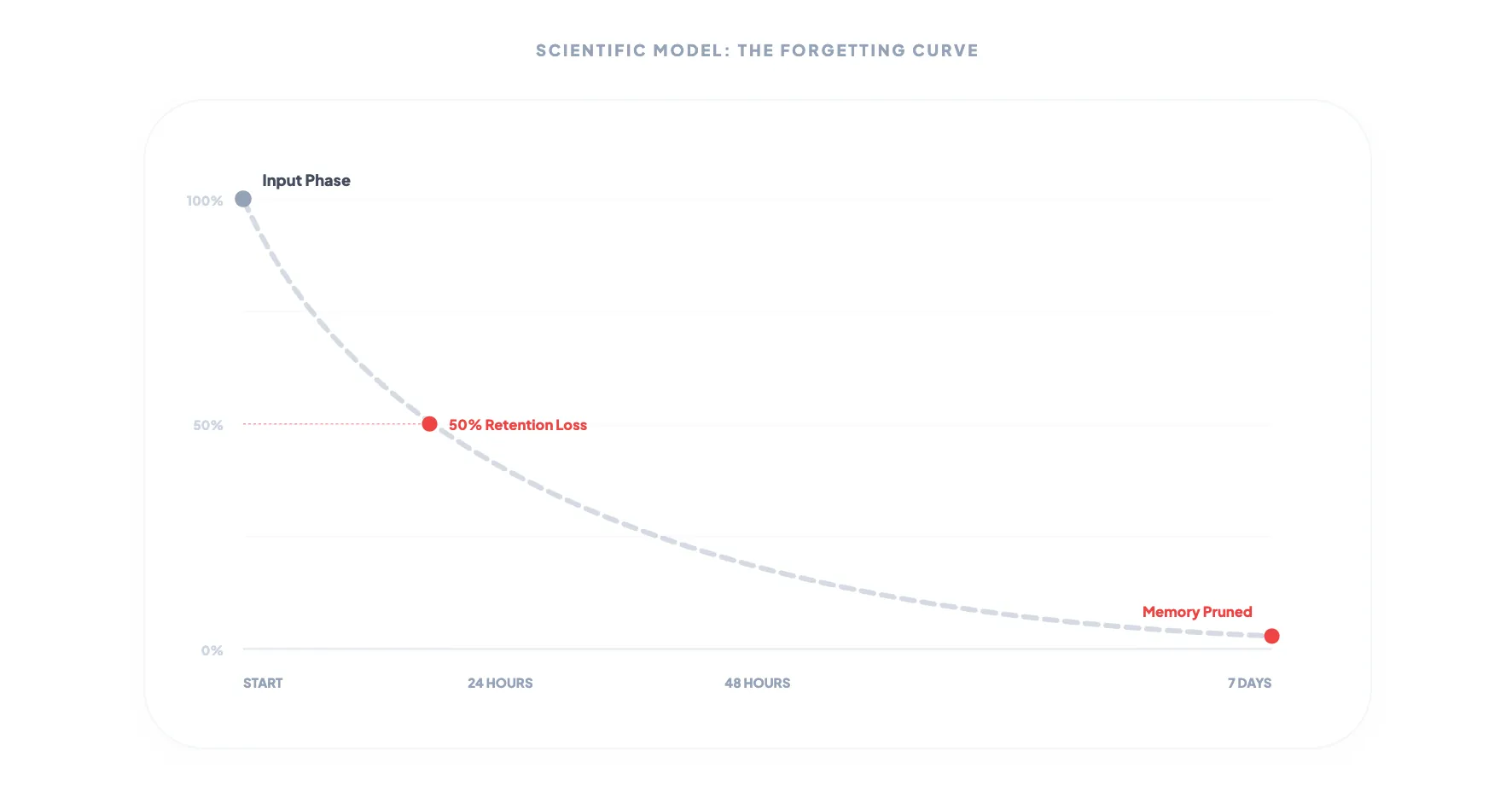
In the 1880s, German psychologist Hermann Ebbinghaus conducted a series of experiments on his own memory that changed how scientists think about learning. He memorized lists of nonsense syllables, then tested himself at intervals to see how much he retained.
What he found became known as the forgetting curve: without any review, humans forget roughly 50% of new information within a day, and up to 90% within a week.
This is not a personal failing. It is how every human brain works. Your brain does not store information permanently just because you encountered it. It stores information in proportion to how often and how deliberately you retrieve it.
The implication for SAT prep is devastating for the cramming model: a student who spends four hours reviewing algebra on a Saturday and doesn't return to it for two weeks has effectively forgotten most of what they reviewed before they even get to apply it. The session felt productive. The retention is close to zero.
What spaced repetition actually is — and what the research says
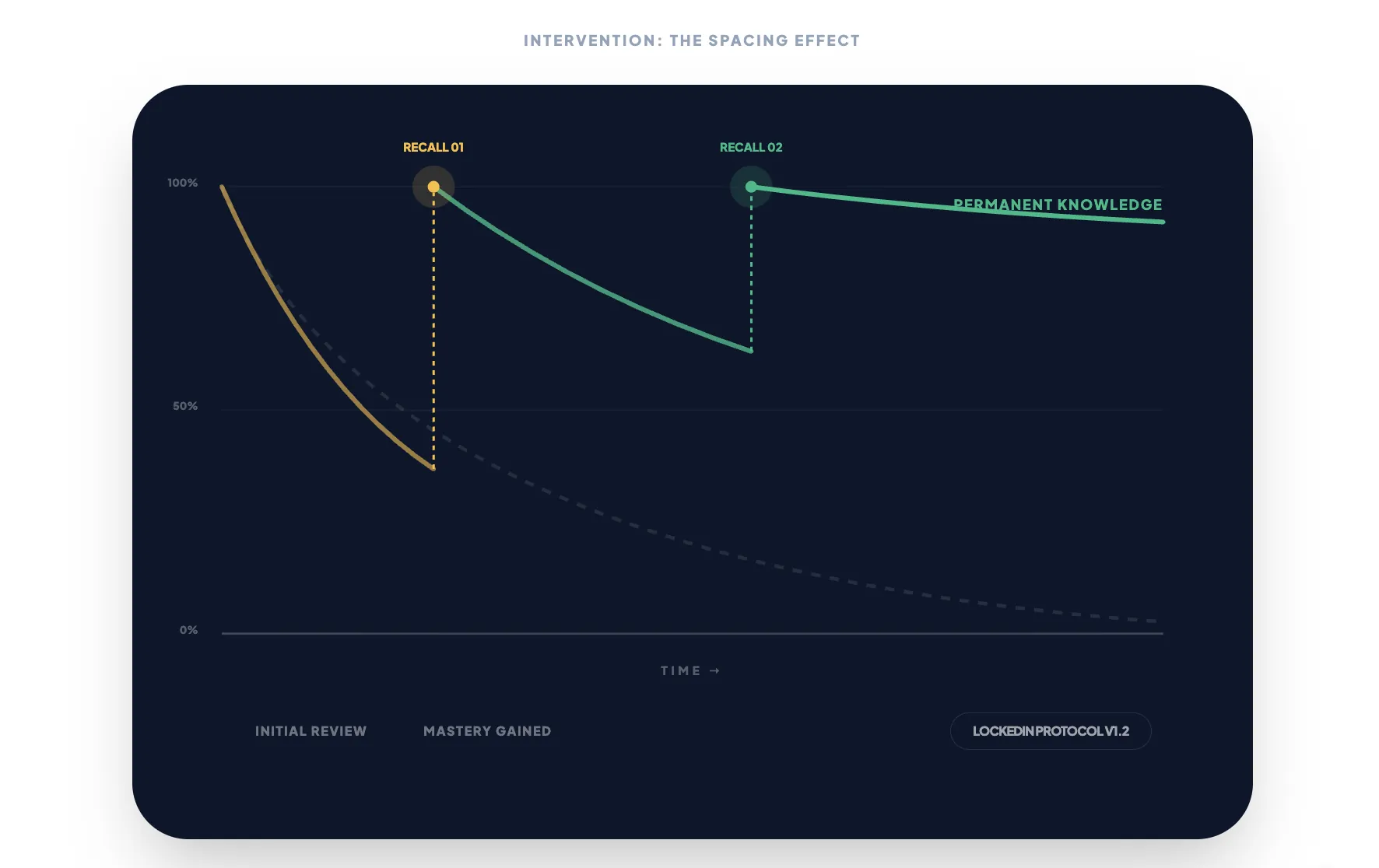
Spaced repetition is the practice of reviewing material at increasing intervals over time rather than in one concentrated session. It is the direct antidote to the forgetting curve.
The mechanism works like this: just before a memory begins to fade — just as you're starting to forget something — you retrieve it. That act of retrieval under slight difficulty strengthens the memory pathway significantly more than retrieving information you remember easily. The memory is reconsolidated at a higher strength level. The next review can be spaced further out. And the next further still.
The research base behind this is enormous and consistent. The benefit of distributing learning over time — known as the spacing effect — has been demonstrated in over 200 research studies from over a century of research.
The magnitude of the effect is not small. As per statistics gleaned from over 800 experiments, learning using the spaced repetition method improves long-term retention by 200% compared to cramming. A 2013 meta-analysis in Psychological Bulletin found that spaced learning improves retention by up to 50% compared to cramming.
For SAT prep specifically: studying one topic for 3 hours straight (massed practice) produces weaker learning than studying the same topic for 30 minutes on 6 different days spread over 2 weeks. This feels counterintuitive — concentrated intensity seems like it should work better. The neuroscience is clear that it doesn't.
Why cramming feels like it's working (and why that feeling lies to you)
Here is the uncomfortable truth about cramming: it does work — in the short term.
If you cram algebra the night before a practice test, you will perform better on that practice test than if you hadn't studied at all. Your brain will feel sharp, familiar, confident. You'll think the session was effective.
Massed repetition for memory encoding provides ease and fluency for immediate conscious retrieval. However, doing such is not ideal for long-term memory enhancement. Cognitive scientists call this the fluency illusion — material that has been recently crammed feels known, but it hasn't been encoded into long-term memory. It lives in working memory, which decays within days.
Cramming can trick students into thinking they know the material, only to wake up the next day having lost things they knew before. Spacing shows them what they truly understand — and what needs more practice.
The real SAT is not taken the day after your cram session. It is taken weeks or months after your preparation begins. The material you need on test day needs to be in long-term memory — the kind that survives time, sleep, stress, and a completely different environment. Cramming does not put it there.
It has been repeatedly demonstrated that students who space their studying out score higher than students who do massed practice on assessments that are given weeks after the initial learning has been done.
The numbers: what score improvement actually looks like
This is not theoretical. The score data matches the science.
Most students need 40–120 hours of focused study distributed over 2–6 months to see significant SAT score improvements. The ideal timeline is 3–6 months for improvements of 200+ points, 2–3 months for 100–150 point gains, and 1 month for 50–100 point increases. Consistent daily practice of 30–60 minutes yields better results than marathon cramming sessions.
A student with a tutor who identifies weak areas and structures a focused curriculum might improve 80–120 points in 12 weeks, while a student of equivalent ability but studying solo and unfocused might improve only 30–50 points in the same time. This is not because tutoring is magical — it is because feedback, structure, and specificity matter.
Read that carefully. The gap between the tutored and untutored student in that study isn't about content knowledge. It's about structure, feedback, and specificity — all things that a well-designed daily practice system can provide without a $200-per-hour tutor.
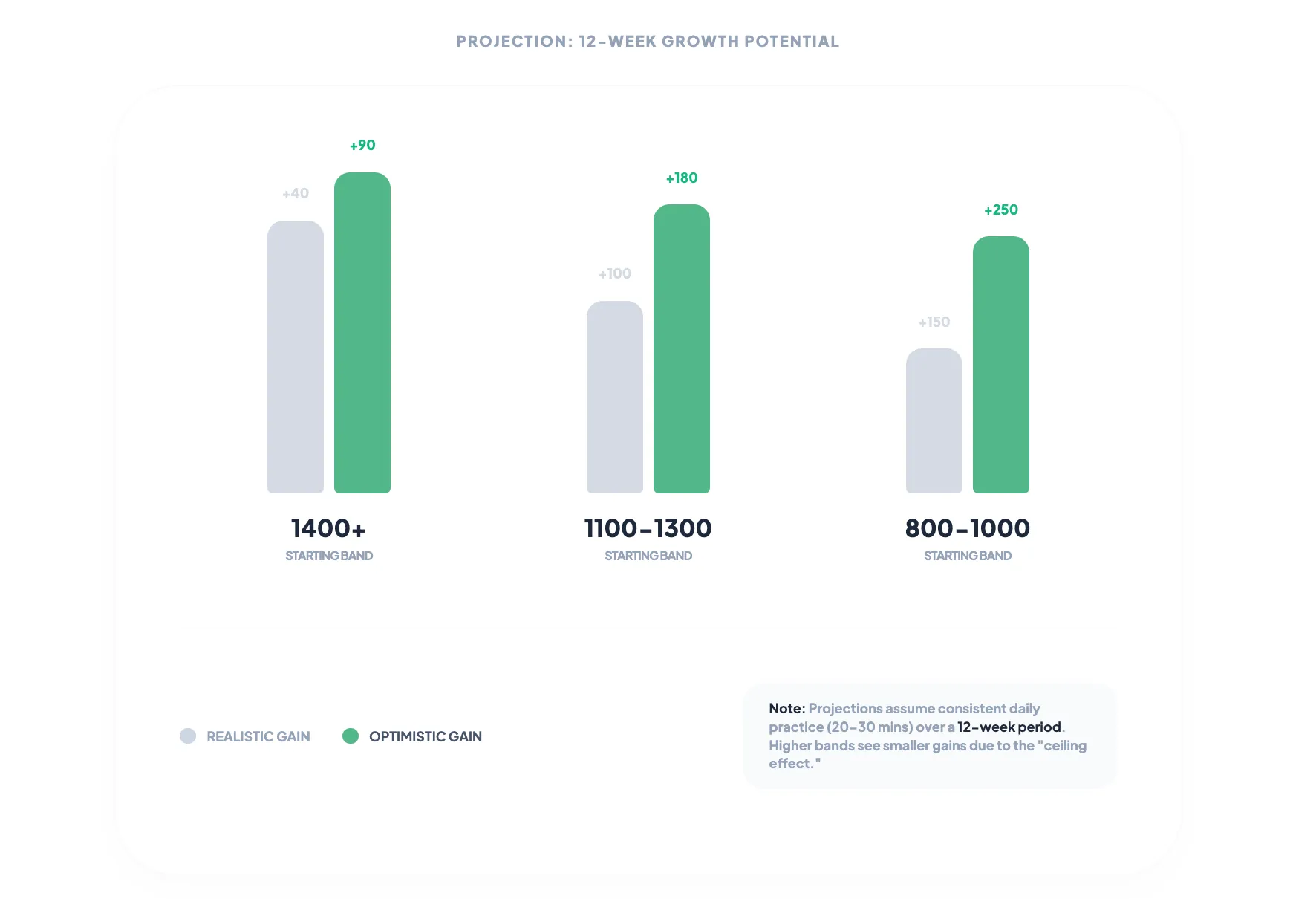
Here is a realistic improvement framework based on starting score and study approach:
| Starting score | Study approach | 12-week realistic gain | 12-week optimistic gain |
|---|---|---|---|
| 950–1050 | Daily spaced practice | +100 pts | +150–200 pts |
| 1100–1200 | Daily spaced practice | +80–100 pts | +150 pts |
| 1250–1350 | Daily spaced practice | +50–100 pts | +100–150 pts |
| 1400+ | Daily spaced practice | +20–80 pts | +80–150 pts |
These targets assume consistent study of 8–10 hours per week and targeted work on weak areas, not random practice. Students who study more intensively or for longer can push toward the optimistic end of these ranges.
The students hitting the optimistic end of these ranges are not working harder per session. They are working more consistently, more specifically, and with better feedback loops.
The daily practice advantage: what 20 minutes a day actually does
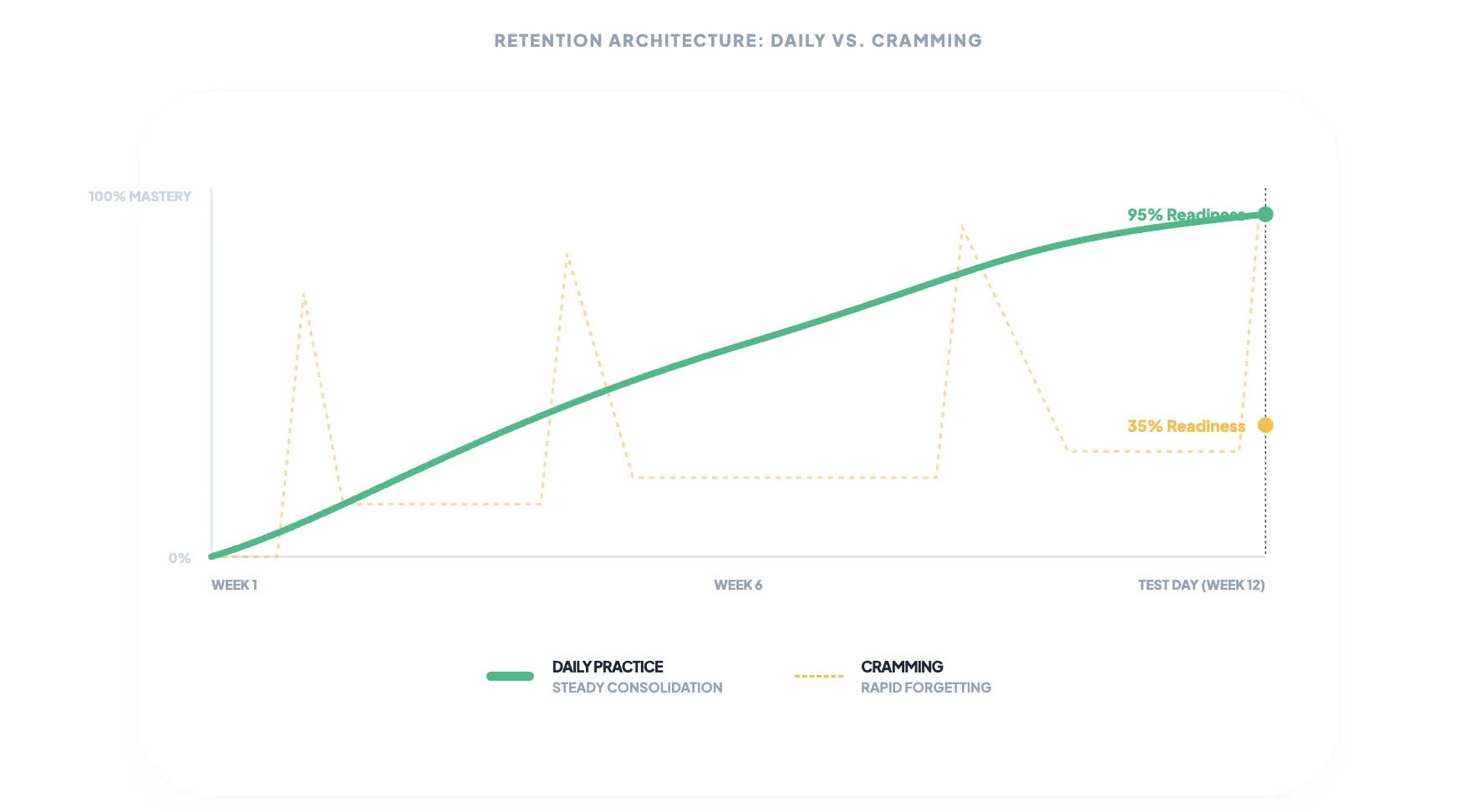
Ideally, 20 to 30 minutes of focused daily practice works best. Consistency matters more than session length. Seven short sessions across a week beats one long session on the weekend.
This is the single most important sentence in SAT prep, and almost no student believes it until they experience it.
Here is why it works mechanically:
Sleep consolidates memory. Every night, your brain replays and consolidates the day's learning into long-term memory. This process — called memory consolidation — happens during sleep and cannot be replicated by staying awake longer. Spaced studying takes advantage of the well-documented fact that sleep consolidates memory. A student who studies for 20 minutes daily gets 7 consolidation cycles per week. A student who crams for 3 hours on Saturday gets 1.
Retrieval effort strengthens memory. When you come back to a concept after a day or two of not thinking about it, you have to work slightly harder to retrieve it. That effort is the mechanism. That small amount of "forgetting" between sessions, and the ensuing effort it takes to recall them, actually strengthens memory pathways, making the information easier to recall later.
Short sessions protect focus. Students could spend 3 hours studying all at once, or spend 30 minutes studying each day for 6 days — the same total time, but students learn and remember significantly more with spacing. The difference is not mystical — it's that 30 minutes of genuine focus is more cognitively efficient than hour three of a marathon session where attention has long since wandered.
Consistency compounds. A student doing 20 minutes per day for 12 weeks accumulates 28 hours of study. That same student doing four 7-hour marathon weekends accumulates 28 hours too. But the daily student's retention at week 12 will be dramatically higher — because every session reviewed and reinforced what came before it.
How to apply spaced repetition to SAT prep specifically
The science is established. Here's what it looks like in practice.
Start with a diagnostic
Before you space anything, you need to know what to space. Take a full-length Bluebook practice test. Get your score report. Identify your weakest domains — the specific question types within Math and Reading & Writing where you're leaving the most points on the table.
These weak domains become your primary study targets. Strong domains still need maintenance — but the majority of your daily practice should hit your gaps.
Build the spaced review cycle
The optimal spaced repetition schedule for SAT concepts looks like this: review a concept on day 1 after learning it, again on day 3, again after 1 week, again after 2 weeks. This pattern prevents both the cramming trap and the "learning once and forgetting" trap.
In practice, you don't need to track this manually. The right system tracks it for you. Daily drills that rotate through your weak areas — resurfacing concepts on the right schedule — do the cognitive work of spaced repetition automatically.
Interleave, don't block
Most students study one topic until they feel comfortable with it, then move on. This feels efficient. It isn't.
Instead of "study algebra for 2 weeks straight," the optimal schedule is: do 20 algebra problems this week, 20 next week, 15 the week after — with review of prior topics interspersed. This feels less intense than cramming a topic, but the cognitive science clearly shows it produces better results.
Mixing question types within a single study session — algebra problems followed by grammar questions followed by function notation — is called interleaving. It's harder in the moment because you can't just apply the same method repeatedly. But that difficulty is precisely what makes it more effective: it forces your brain to identify which approach each question requires, which is exactly what the SAT demands.
Practice retrieval, not re-reading
The least effective study strategy for any high-stakes test is re-reading notes or textbook pages. It creates familiarity — the feeling of knowing — without creating retrievability — the ability to actually recall under pressure.
Every study session should involve actively producing answers, not passively consuming content. Solve problems. Write out explanations. Try to recall grammar rules from memory before checking them. The effort of retrieval is the study.
Track errors, not hours
The number of hours you study tells you almost nothing useful. The number of wrong answers you understand tells you everything.
After every study session, record every incorrect answer: what question type it was, why you got it wrong (content gap, careless error, pacing), and what you'll do differently. This error log becomes your personalized study curriculum — a living document of the specific gaps that are costing you points.
What this means for how you choose a prep system
Not all SAT prep systems are built on the right learning science. Most are built on what feels effective rather than what is effective.
A system built on spaced repetition looks like this:
- Small amounts of material delivered consistently over time
- Problems that rotate back to earlier topics at regular intervals
- Immediate feedback on what went wrong and why
- Tracking that surfaces your weakest areas automatically
- Zero friction — so that actually showing up daily is sustainable
A system built on what feels effective looks like this:
- Large course books you study in blocks
- Marathon weekend sessions
- Re-reading explanations after getting something wrong
- No systematic review of older material
You don't need to pay for a private tutor or an SAT prep class to improve your SAT scores. The best way to practice for the digital SAT is free. What you need is the right structure — one that puts the science to work automatically, so you don't have to manually manage your own spaced review schedule on top of everything else you're juggling.
Why LockedIn was built this way
LockedIn is a free nonprofit SAT prep platform built by SAT takers who understood one thing clearly: the biggest obstacle to score improvement isn't access to content. It's consistency.
Every major prep resource — Bluebook, Khan Academy, the College Board question bank — is free and excellent. The content has never been the problem. The problem is that sitting down to open a prep book requires activation energy that compounds over time. Life gets in the way. Sessions get skipped. The study schedule that started strong in week one quietly dies by week three.
LockedIn solves this by delivering problems to you. You set the volume. You set the schedule. The drill lands in your inbox at the time you chose, every day. Your dashboard tracks which domains you're struggling with and surfaces patterns automatically.
It's not a magic system. It's just the right structure applied consistently — which is exactly what the science says produces the best results.
Daily practice. Spaced repetition. Zero cost. No excuses.
Start for free at lockedin.study →
The short version
Cramming feels effective because it produces short-term recall. The SAT is not taken the day after you cram. Long-term memory — the kind you need on test day — is built through spaced repetition: small amounts of material reviewed at increasing intervals over weeks and months. The research on this is over a century old, replicated in hundreds of studies, and unambiguous. Seven 20-minute sessions outperform one 3-hour session every time. The students who improve by 200+ points are not the ones who study the hardest in a single burst. They're the ones who show up every day.
Sources
- Ebbinghaus, H. (1885). Über das Gedächtnis. Leipzig: Duncker & Humblot. (The original forgetting curve research)
- Carpenter, S. K., Pan, S. C., & Butler, A. C. (2022). The science of effective learning with spacing and retrieval practice. Nature Reviews Psychology, 1(9), 496–511. — Read summary
- Cepeda, N. J., et al. (2006). Distributed practice in verbal recall tasks: A review and quantitative synthesis. Psychological Bulletin, 132(3), 354–380. — 800+ experiments confirming spacing effect
- Kornell, N., & Bjork, R. A. (2008). Learning concepts and categories: Is spacing the "enemy of induction"? Psychological Science, 19(6), 585–592.
- Mindko (2025). How to study for the SAT. — Read article
- AdmitStudio (2026). SAT realistic score improvement expectations. — Read article
- AdmitStudio (2026). Spaced repetition and cognitive science for SAT prep. — Read article
- UCSD Department of Psychology. Spaced practice. — Read article
- Engaging Minds (2024). Why spaced study is far more effective than cramming. — Read article
- College Board (2024). How to improve your SAT score. — Read article
- PMC / NIH. Evidence of the spacing effect and influences on perceptions of learning. — Read study
Related: How to study for the SAT effectively: the no-BS blueprint Related: Free SAT prep resources that actually work in 2026 Related: SAT study schedule: 4-week, 8-week, and 12-week plans
LockedIn is a nonprofit SAT prep platform — free forever, built for students who are serious about their score. Get started at lockedin.study.
Enjoyed the read?
Join 10,000+ students getting elite SAT drills every morning at 5:00 AM.