SAT Test Anxiety: The Complete Science-Backed Guide to Performing at Your Best on Test Day
SAT Test Anxiety: The Complete Science-Backed Guide to Performing at Your Best on Test Day
There is a version of you that exists in a practice test environment — calm, focused, methodical — who scores significantly higher than the version of you that sits down in a real testing room.
For a lot of students, that gap is not hypothetical. It's real, it's measurable, and it has a name: test anxiety. And unlike a knowledge gap, which you can close by studying harder, test anxiety requires a different kind of preparation entirely.
This guide is for anyone who has ever walked out of an SAT feeling like they left points on the table — not because they didn't know the material, but because something went wrong in their head. We're going to cover what test anxiety actually is at a neurological level, what it does to your score, and the specific, evidence-based strategies that eliminate it — not just manage it.
What test anxiety actually is — and what it isn't
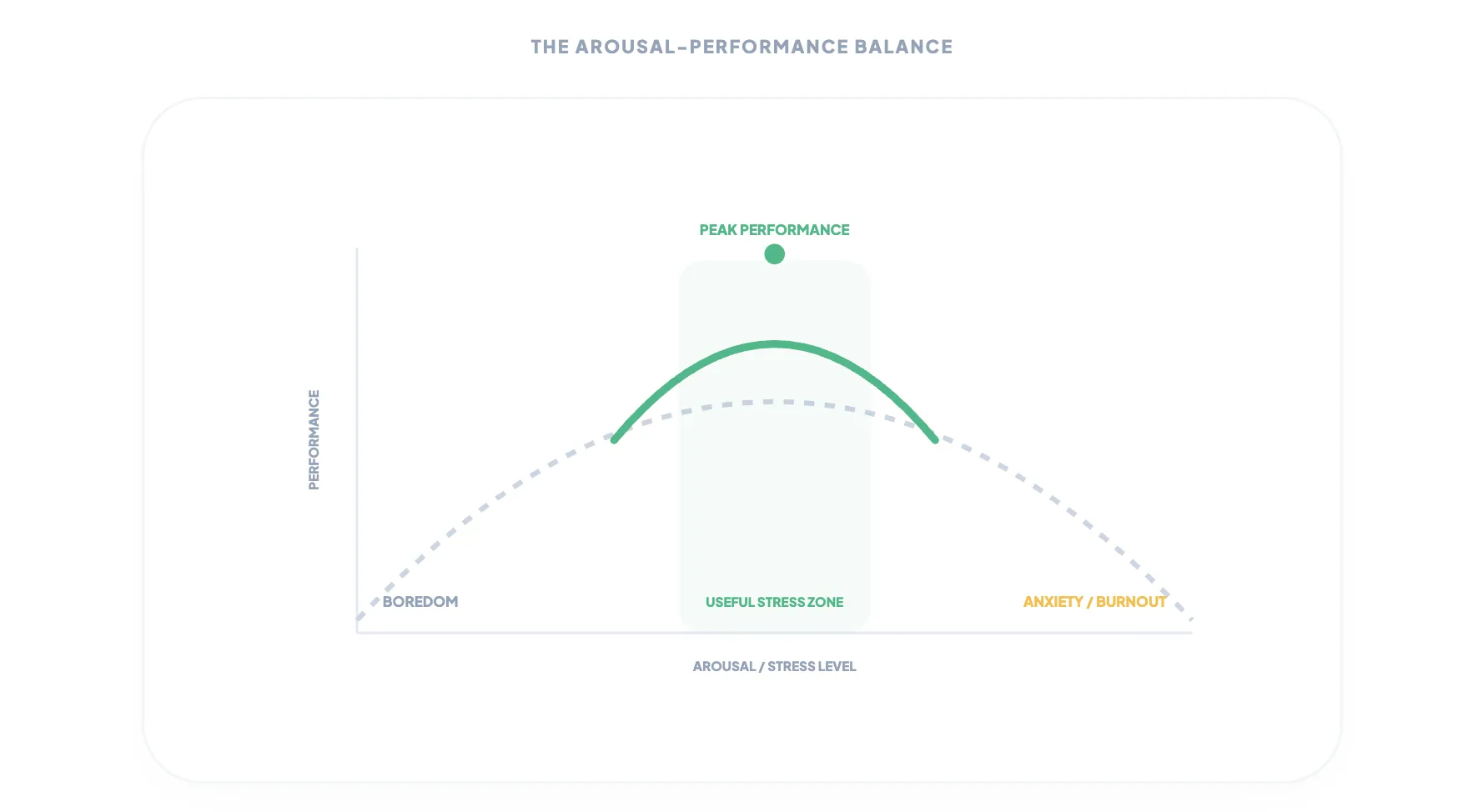
Test anxiety is not the same as being nervous. Everyone is a little nervous before a high-stakes test. That's normal and, in small doses, actually useful — mild activation of the stress response sharpens focus and speeds reaction time.
Test anxiety is what happens when that stress response overshoots. Students with high test anxiety score about 12 percentile points below their low-anxiety peers. That's not a small effect. On the SAT's 1600-point scale, 12 percentile points can represent 80–120 points of suppressed score — points that reflect real ability that simply never makes it onto the page.
Test anxiety manifests across four dimensions: reduced cognitive performance (impeded ability to concentrate, interpret questions, or recall information), increased physical discomfort (sweating, dry mouth, nausea), significant negativity (loss of self-confidence, second-guessing correct answers), and a biochemical stress response (the release of adrenaline and cortisol that can leave a student feeling drained mid-test).
Understanding the difference between useful nerves and counterproductive anxiety is the first step toward managing it. The goal is not to eliminate all stress. The goal is to keep the activation in the useful zone and prevent it from tipping into the zone where it actively undermines performance.
The neuroscience: what anxiety does to your brain during a test
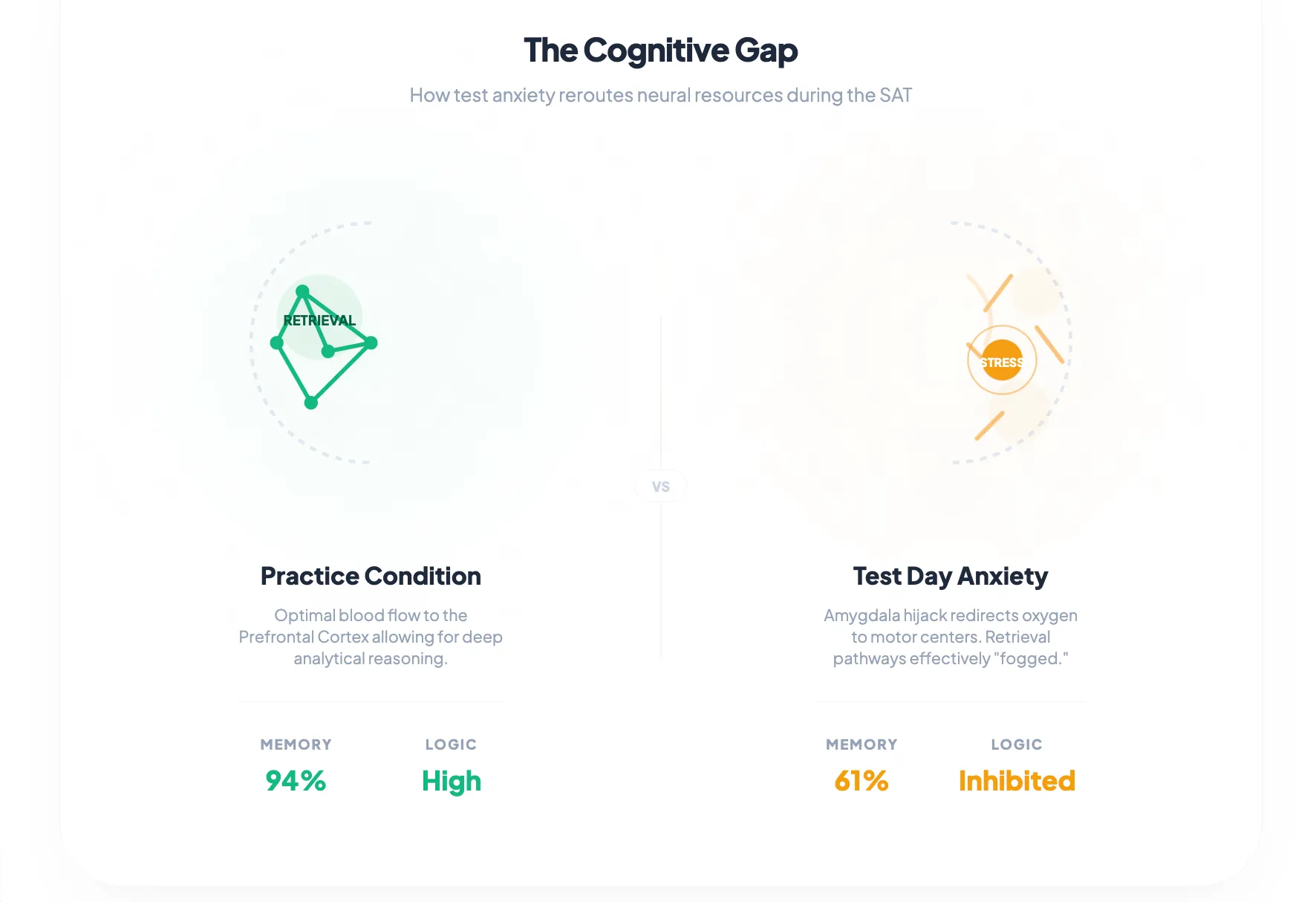
When you perceive a threat — and the brain genuinely cannot distinguish between a tiger and an SAT question that's stumping you — the amygdala fires and triggers the hypothalamic-pituitary-adrenal (HPA) axis. Cortisol and adrenaline flood your system. Blood flow redirects from the prefrontal cortex to the motor and survival centers of the brain.
Here is the problem: the prefrontal cortex is exactly where complex reasoning, working memory, and deliberate problem-solving happen. It is the part of your brain you need most to answer SAT questions. Anxiety literally reroutes the blood supply away from it.
When the stress alarm is too loud, working memory shrinks, and the simple act of reading a sentence or solving an equation becomes harder. The brain's fight-or-flight response, which is designed for physical threats, is catastrophically poorly suited for sitting still and selecting among four answer choices.
This is also why anxious students sometimes forget things they clearly knew in practice. The memory hasn't disappeared. It's inaccessible because the retrieval pathways are being suppressed by cortisol. When students say "I blanked," they are describing a real neurological event, not an excuse.
Catastrophic thinking patterns — "if I fail this question everything is ruined" — and all-or-nothing beliefs — "I must get a perfect score" — are the cognitive fuel that keeps the anxiety response burning throughout the test. Recognizing these patterns is not a soft skill. It is a cognitive intervention with direct, measurable impact on test performance.
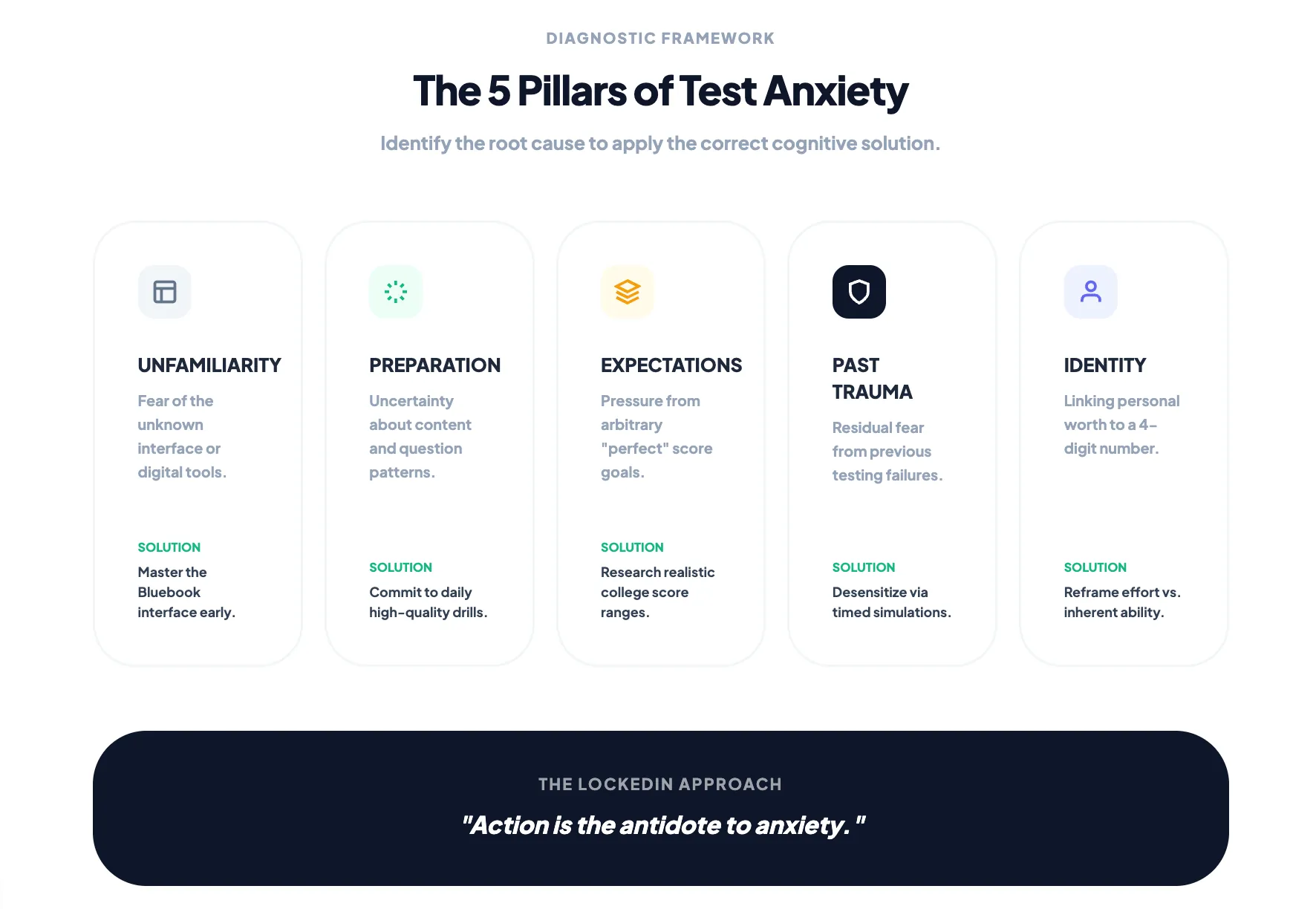
The five root causes of SAT test anxiety
Not all test anxiety has the same origin. Identifying which cause is driving yours determines which solution actually works.
1. Unfamiliarity with the test environment
The biggest source of stress is uncertainty. Every time you practice and get used to question types, layout, and timing, you build confidence and lower your anxiety. Students who have never used the Bluebook interface before test day are not just unprepared for the content — they're spending cognitive resources on navigation, timing displays, and flagging mechanics that should be automatic. That overhead is real and it comes out of the same mental budget as problem-solving.
2. Inadequate preparation
The most honest cause of test anxiety is often the one students least want to admit: they haven't prepared enough, and some part of them knows it. Test anxiety can stem from fear of failure, pressure to perform well, lack of preparation, comparison to peers, and fear of not living up to the expectations of parents or peers. Anxiety that is rooted in genuine under-preparation has only one cure: preparation. No breathing technique will fix a knowledge gap.
3. Unrealistic score targets
Students who target scores far beyond what their dream college requires place themselves under tremendous pressure that is entirely self-generated. Research your target colleges' middle 50% score ranges. If your diagnostic score is 1180 and your safety school needs 1100, your anxiety calculus looks completely different than if you're convinced you need 1550 for a school whose median admit scores 1420.
4. Previous bad experiences
Poor performance in earlier SAT attempts can heighten fear in subsequent attempts. Each negative test experience can strengthen the neural association between "testing environment" and "threat response," making anxiety worse with each retake if not actively addressed. This is addressable — but requires deliberate reconditioning, not just more studying.
5. Performance-identity fusion
When a student believes their score represents their worth as a person or their intelligence as a fixed trait, every question becomes existentially weighted. The SAT does not measure your worth as a person. The more you focus on consistent effort rather than being "naturally smart," the more your anxiety will fade. This isn't feel-good advice — it reflects a decades-long body of research on growth mindset showing that students who attribute outcomes to effort rather than fixed ability perform better and recover faster from failure.
The preparation-based anxiety solution: why consistency is the best anxiolytic
Here is the most important thing you can do for test anxiety that no breathwork app will tell you:
Get so prepared that the test feels familiar.
Simulating test conditions prepares students mentally and physically for the exam environment. A student preparing for the SAT might take full-length practice exams under timed conditions at home. This helps reduce anxiety by making the test feel familiar.
Familiarity is the neurological opposite of the threat response. When the brain encounters a known situation — a question type it has seen a hundred times, an interface it has navigated for months — the amygdala does not fire. There is no threat to respond to.
This is why the students who report the least test-day anxiety are almost always the ones who practiced the most — not because confidence is a personality trait, but because they eliminated the uncertainty that triggers the stress response in the first place.
Try scheduling your practice tests at the same time as the actual SAT exam to train your brain for peak performance. This sounds trivial. It isn't. The brain forms strong contextual associations between environment, time of day, and cognitive state. Practicing at 8am in a quiet room is measurably better preparation for an 8am test than practicing at 10pm in bed.
The daily practice approach — showing up every single day for short, focused sessions — does more for test anxiety than any single-weekend intensive. Each day you practice, you are adding one more data point to your brain's evidence base that these question types are familiar, manageable, and not threatening.
The week-by-week anxiety management timeline
6–12 weeks out: build the foundation
This phase is about eliminating the knowledge gaps that generate legitimate anxiety. Work through your weakest domains systematically. When you create a study schedule, you let your brain take time to absorb information at a steady pace. This is something that helps reduce anxiety and can help improve your performance.
Take full-length Bluebook practice tests every 2–3 weeks. After each one, review every wrong answer — not just to fix the content gap, but to make the test experience normal. The more times you've sat for 2 hours and 14 minutes of digital SAT, the less novel and threatening the experience is.
2–4 weeks out: simulate relentlessly
At least two full-length practice tests under realistic conditions should be scheduled in the final month. Treat them like the real test: same start time, same breaks, same environment as much as possible. Each test is a calibration that teaches you timing, stamina, and your typical mistake patterns.
During this phase, start building a pre-test routine — the specific sequence of actions you'll take the morning of the test. Your brain will begin to associate this routine with performing well. By test day, executing the routine will shift your neurological state toward focus rather than anxiety.
7–10 days out: stop learning new things
About 7–10 days out, stop learning big new concepts. Focus instead on light review, targeted practice where weaknesses remain, and relaxation. Cramming at the last minute tends to increase anxiety, not performance.
This is the phase most students do wrong. They panic, ramp up studying, and arrive at test day mentally exhausted and more anxious than if they had done nothing. The last week before the SAT should be about maintenance and rest — not acquisition.
Light daily practice (20–30 minutes) on familiar question types reinforces confidence without depleting cognitive resources. Think of it as a maintenance run, not a training sprint.
The night before: protect your sleep
Sleep is the foundation of clear thinking. Aim for 7–9 hours of sleep, especially before a test. Well-rested students process information more accurately and maintain better attention during long exam sessions. Sleep also supports memory consolidation — information you studied is more likely to stick.
No study session the night before is worth the cost of disrupted sleep. The math is unambiguous: a fully rested brain with slightly less last-minute review outperforms an exhausted brain with more. Set a hard stop time for any test-related activity — 9pm at the latest — and protect the remaining hours.
Turn off devices an hour before bed, dim the lights, and lay out your clothes for the next day. Each item you don't have to think about in the morning is one fewer source of cortisol.
In-the-moment techniques: what to do when anxiety hits during the test
Even with thorough preparation, anxiety can spike during a test. These are the techniques with the strongest evidence base for in-the-moment recovery.
Controlled breathing: the 4-7-8 method
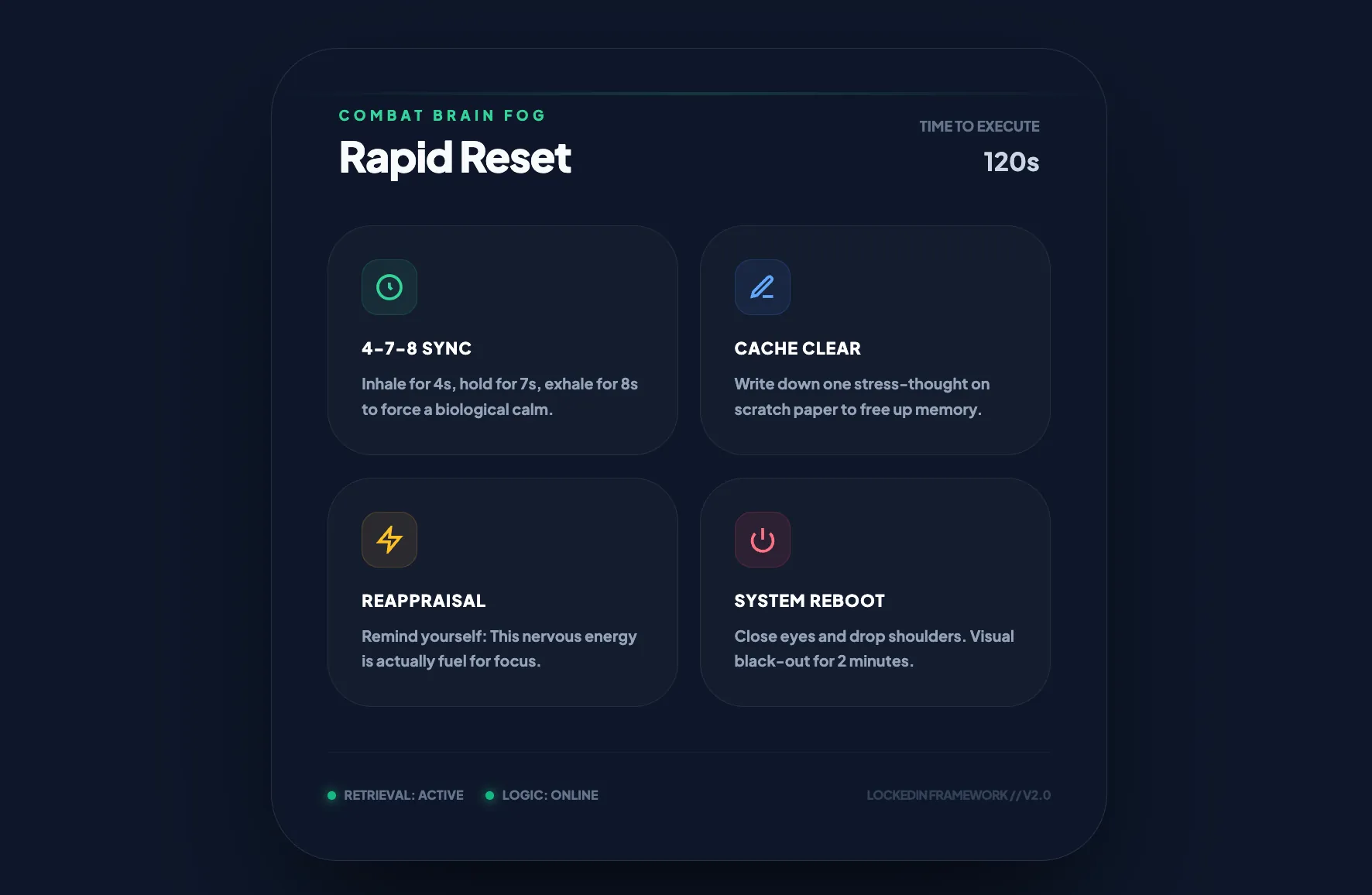
Inhale quietly through your nose for 4 seconds, hold for 7 seconds, and exhale slowly through your mouth for 8 seconds. Repeat three to four times. It slows heart rate and sends a message to your nervous system that you're safe and focused.
The physiological mechanism is real: slow exhalation activates the parasympathetic nervous system, directly counteracting the fight-or-flight response. This takes under 30 seconds and can be done silently at your desk between questions.
The "brain dump" before you begin
According to research from the University of Chicago, writing down your fears on a slip of paper about 10 minutes before the test — including all your worries, fears, anxieties, and negative thoughts — and then disposing of it frees up cognitive capacity. Like clearing the cache on your computer, it helps you be more clear-minded for the test.
The mechanism: rumination and worry consume working memory capacity. Externalizing the anxiety onto paper offloads it from active cognitive processing. The effect is measurable in performance outcomes.
Reframe anxiety as activation
Research from Harvard psychologist Alison Wood Brooks (2014) found that telling yourself "I am excited" rather than "I am calm" before a high-stakes performance — including academic tests — significantly improved performance outcomes. The physiological states of anxiety and excitement are nearly identical (elevated heart rate, heightened awareness, adrenaline). The difference is cognitive labeling. Reframing "I'm anxious" as "I'm activated and ready" is not self-deception — it is a neurologically accurate reinterpretation of the same physical state.
The two-minute reset
If you hit a question that is causing a spiral — you've read it three times and you're getting more confused, not less — flag it immediately and move on. Do not negotiate with a question that is consuming disproportionate time and emotional energy. Chunking strategies for your brain bring you back to the present — tackle the next question as its own independent task, entirely disconnected from the one you flagged.
When you return to the flagged question with fresh eyes, the anxiety spike from the first encounter has usually dissipated, and you'll read it more clearly.
Grounding: the 5-4-3-2-1 technique
If anxiety becomes physically acute during the test — racing heart, tunnel vision, difficulty focusing — use a brief sensory grounding exercise. Silently identify 5 things you can see, 4 things you can feel physically, 3 things you can hear, 2 things you can smell, 1 thing you can taste. This interrupts catastrophic thought loops by redirecting neural attention to concrete sensory input.
Test day logistics: eliminate every controllable stressor
A significant portion of test-day anxiety comes from controllable logistical sources that students consistently overlook until the morning of the test.
Nothing spikes anxiety like last-minute surprises. Get everything sorted beforehand: know your test center location, pack your essentials (admission ticket, government-issued photo ID), and arrive at least 30 minutes early to avoid last-minute panic.
The complete pre-test checklist:
Night before:
- Lay out all required materials: admission ticket (printed or on phone), valid photo ID, approved calculator if bringing one, snacks and water for the break
- Set two alarms
- Identify your route to the test center including parking or transit
- Eat a real dinner — not junk food that will affect sleep quality
- Hard stop on studying by 9pm
- Lights out by 10pm
Morning of:
- Wake with enough time to not be rushed — rushing is a direct cortisol trigger
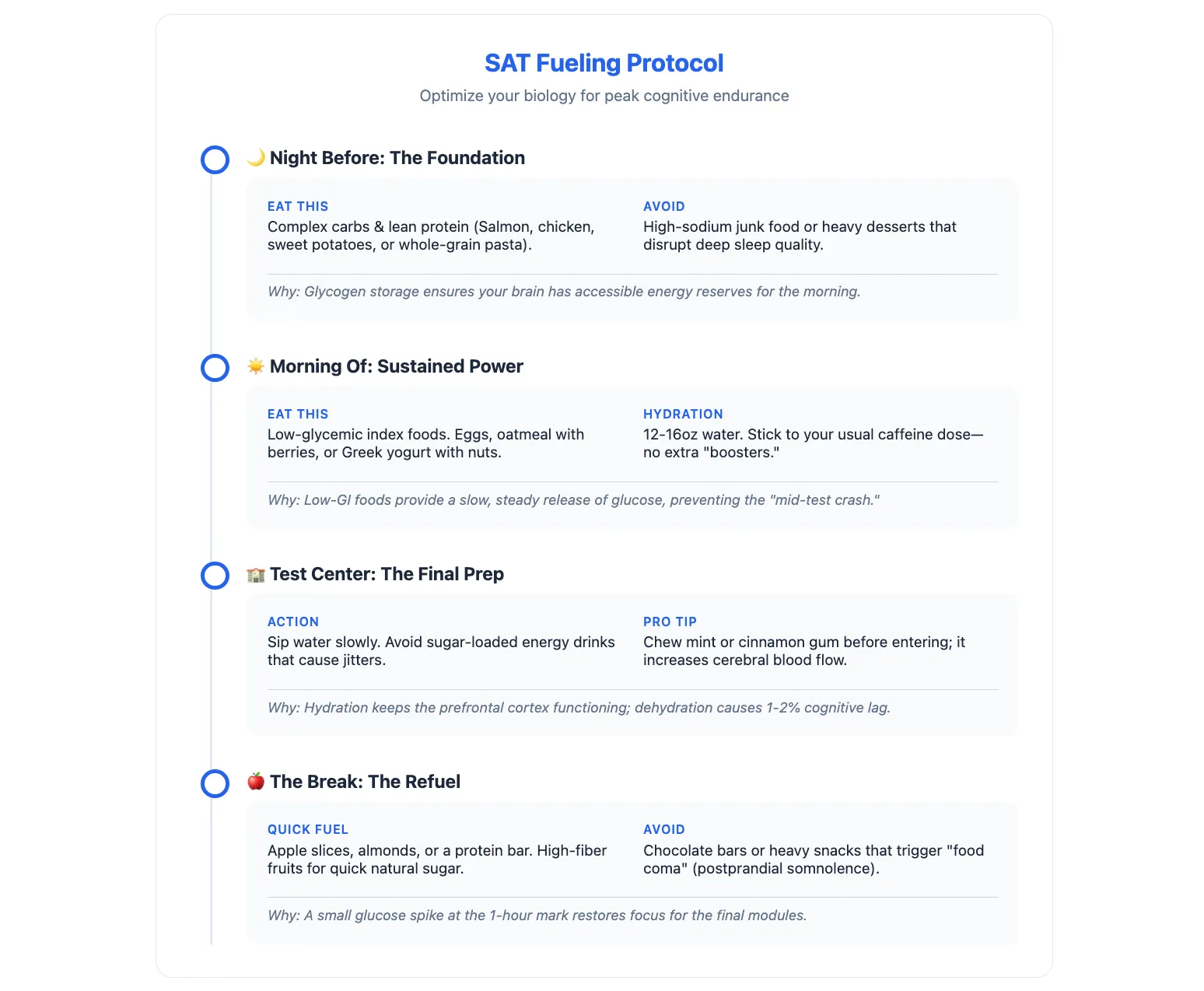
- Eat a protein-rich breakfast with complex carbohydrates (eggs, oatmeal, nuts) — not sugary cereal or nothing
- Light exercise helps regulate stress. Even a 10-minute walk before a test can reduce cortisol, the hormone linked to anxiety.
- Review your pre-test routine, not new content
- Arrive 30 minutes early — being early turns the test center from a threatening unknown into a familiar room
At the test center:
- Don't compare preparation with other students in the waiting area — it serves no purpose and generates anxiety
- Use the time before the test begins for slow breathing, not last-minute reviewing
- Execute your pre-established strategy from the first question — don't improvise
The nutrition and sleep protocol that most guides ignore
Most SAT prep advice skips the physical performance component entirely. This is a mistake. The brain is an organ. It runs on blood sugar, oxygen, sleep-consolidated memory, and hydration. Test performance is partly a physiological outcome.
Sleep: The two nights before the test matter as much as the night before. Sleep debt accumulated over a week of stress and late-night studying cannot be repaid in a single good night. Go to bed 10–15 minutes earlier each night in the two weeks before the test until you hit your goal bedtime. Gradual adjustment is more effective than a sudden schedule change.
Nutrition on test day: The SAT runs for over two hours. Blood sugar management during that time is real. Choose meals with protein and complex carbohydrates such as whole grains, eggs, lean meats, or nuts. These foods release energy slowly, keeping you alert without crashing. Avoid excess sugar or caffeine, which can lead to jitteriness or energy dips during the test.
Bring a snack for the break between sections — something with protein and natural sugar (a handful of almonds and a banana, for example). The break is the right moment for a small glucose refuel, not a heavy meal that redirects blood flow to digestion.
Hydration: Mild dehydration (as little as 1–2% body water loss) measurably impairs cognitive performance. Drink water consistently in the days before the test and bring a bottle for the testing room if permitted.
Caffeine: If you regularly drink coffee, have your normal amount — not more. Caffeine amplifies anxiety in proportion to the dose and your baseline tolerance. Test day is not the moment to discover that two espressos makes you jittery.
The mindset shift that changes everything
Here is the reframe that elite performers in every high-pressure field eventually arrive at:
The SAT is not a judgment of your intelligence. It is a performance of a specific, learnable skill set.
Musicians don't walk onto stage believing the concert will reveal whether they are secretly untalented. Athletes don't step up to the starting blocks believing the race will expose some fundamental inadequacy. They have prepared. They have rehearsed. They trust the preparation and execute.
Your mindset can make or break your test performance. Instead of "I'm going to fail," tell yourself, "I've prepared well, and I will do my best." Confidence can significantly impact your results.
The students who perform closest to their potential on test day are the ones who have internalized this: they are not being tested on who they are. They are demonstrating a skill they have built. If the preparation was good, the performance will reflect it. If the preparation was insufficient, the solution is more preparation — not anxiety.
After each practice session, record what went well. These little wins are confidence currency. On anxious days, review your list to remind yourself that progress is happening.
How daily practice eliminates test anxiety at the root
The most durable solution to SAT test anxiety is not a technique you apply on test day. It is a practice habit you build over months.
When you have solved thousands of SAT-style problems — when the question formats are so familiar that you recognize the question type from the first sentence, when the timing pressure is a known and manageable challenge rather than an unknown threat — the SAT stops being scary. It becomes a familiar task that you have done, in various forms, hundreds of times before.
This is the psychological argument for daily practice that goes beyond just the cognitive science of spaced repetition. Daily reps don't just build knowledge. They build the deep familiarity that prevents the amygdala from treating the test as a threat in the first place.
LockedIn delivers daily SAT drills directly to your inbox — the exact question types, the same pressure, the same formats you'll see on test day. Every day you do the drill, you are not just learning content. You are training your brain to treat SAT questions as familiar and non-threatening.
Free. Nonprofit. No excuses.
Start building test-day confidence at lockedin.study →
Quick reference: the complete SAT anxiety toolkit
| When | Strategy | Why it works |
|---|---|---|
| 6–12 weeks out | Close knowledge gaps systematically | Genuine under-preparation is the #1 anxiety cause |
| 6–12 weeks out | Daily Bluebook-format practice | Builds familiarity that prevents threat response |
| 2–4 weeks out | Full-length tests at same time as real SAT | Trains circadian peak performance |
| 7–10 days out | Stop learning new concepts | Prevents cognitive depletion before test day |
| Night before | Hard stop at 9pm; 8–9 hours sleep | Sleep consolidates memory and resets stress hormones |
| Morning of | Protein breakfast + 10-min walk | Stabilizes blood sugar and reduces cortisol |
| Arrive early | 30 min before test start | Turns unfamiliar environment into known territory |
| During test | 4-7-8 breathing on anxiety spike | Activates parasympathetic nervous system |
| During test | Flag and move on hard questions | Prevents anxiety from compounding |
| During test | Reframe anxiety as activation | Converts cortisol into useful arousal |
| Any time | Write down fears, then discard | Frees working memory from rumination |
Sources
- Edison OS (2025). How to help students through SAT test anxiety. — Read article
- Learnfully (2025). The complete guide to beating ACT and SAT test anxiety. — Read article
- GrowingMindsAAC (2025). How to manage SAT test anxiety with effective stress management techniques. — Read article
- Sparkl (2025). How to beat test anxiety before the SAT: calm, confident, and ready. — Read article
- Test Innovators (2025). 9 ways to help your student combat ACT and SAT test anxiety. — Read article
- JRA Educational Consulting (2025). SAT/ACT test anxiety: 10 tips. — Read article
- CollegeVine Blog. Beating SAT anxiety: 7 ways to ace test day. — Read article
- Math Around the Corner (2025). Test-taking tips to reduce anxiety and improve scores. — Read article
- Tutela Prep (2025). SAT exam tips for US students. — Read article
- Brooks, A.W. (2014). Get excited: Reappraising pre-performance anxiety as excitement. Journal of Experimental Psychology: General, 143(3), 1144–1158. — Read abstract
- Yerkes, R.M., & Dodson, J.D. (1908). The relation of strength of stimulus to rapidity of habit-formation. Journal of Comparative Neurology and Psychology, 18(5), 459–482. (The original Yerkes-Dodson inverted U-curve research)
- Love the SAT Test Prep (2025). Enhance SAT performance and decrease test anxiety with meditation. — Read article
Related: Why everything you know about studying for the SAT is wrong Related: How to study for the SAT effectively: the no-BS blueprint Related: Digital SAT adaptive format explained: how to use it to your advantage
LockedIn is a nonprofit SAT prep platform — free forever, built for students who are serious about their score. Get started at lockedin.study.
Enjoyed the read?
Join 10,000+ students getting elite SAT drills every morning at 5:00 AM.