SAT Reading & Writing Tips: How to Ace Every Question Type
SAT Reading & Writing Tips: How to Ace Every Question Type
Most students approach the SAT Reading & Writing section the wrong way. They treat it like a literature class — reading carefully, forming opinions, drawing on background knowledge.
That approach will cost you points.
The SAT Reading & Writing section is not a reading comprehension test in any traditional sense. It's a reasoning test that happens to use short passages. Every answer is either directly supported by the text or it isn't. Every wrong answer is wrong for a specific, identifiable reason. There is no interpretation. There is no "I think the author meant." There is only: what does the passage actually say?
Once you understand that, the whole section becomes a different game — and a much more winnable one.
How the section is structured
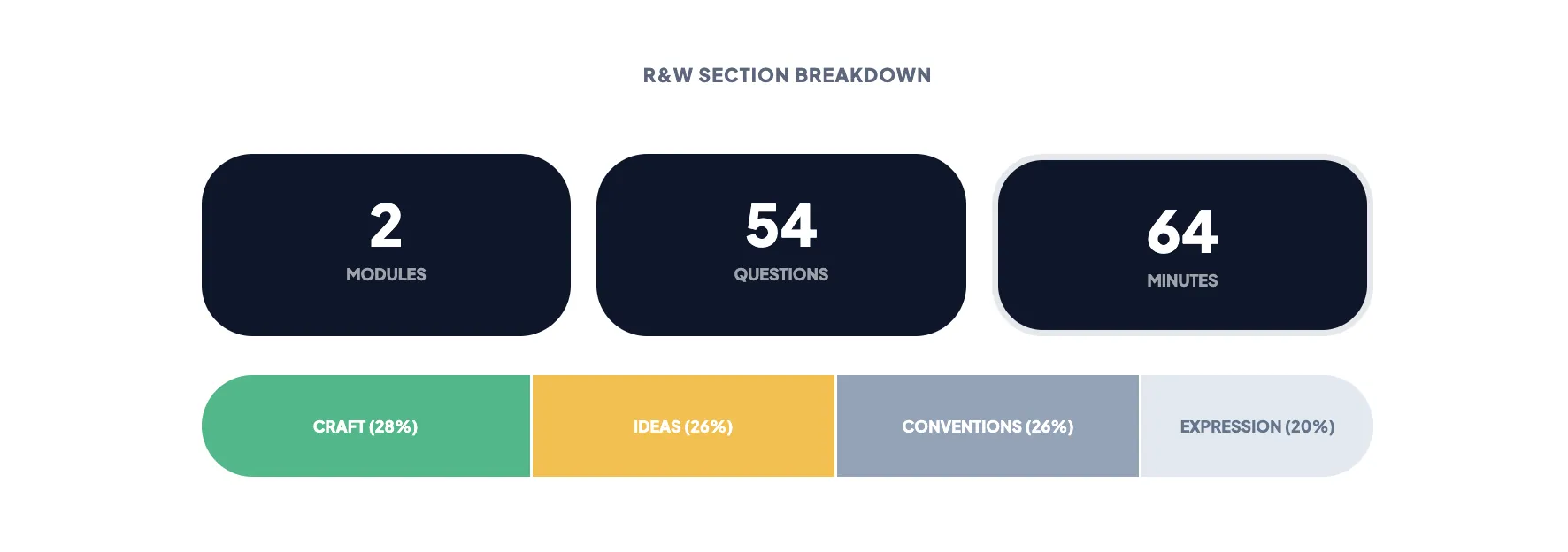
The Reading & Writing section has two modules of 27 questions each, totaling 54 questions in 64 minutes. That works out to approximately 71 seconds per question — tight, but manageable with the right approach.
The College Board groups Reading & Writing questions into four domains:
| Domain | Share of section | What it tests |
|---|---|---|
| Information & Ideas | ~26% | Reading comprehension, evidence, inference |
| Craft & Structure | ~28% | Vocabulary in context, text structure, purpose, cross-text connections |
| Expression of Ideas | ~20% | Rhetorical synthesis, transitions |
| Standard English Conventions | ~26% | Grammar, punctuation, sentence structure |
Two things stand out. First, Standard English Conventions (grammar and punctuation) makes up about a quarter of the section and follows strict, learnable rules — it has the highest ROI of any domain for time invested. Second, Craft & Structure is the largest domain and the one most students find hardest, because it requires understanding why a passage is written a certain way, not just what it says.
The universal Reading & Writing strategy
Before diving into specific question types, one rule applies to all of them:
Find the answer in the text before looking at the choices.
This sounds obvious. Almost no one does it consistently under time pressure.
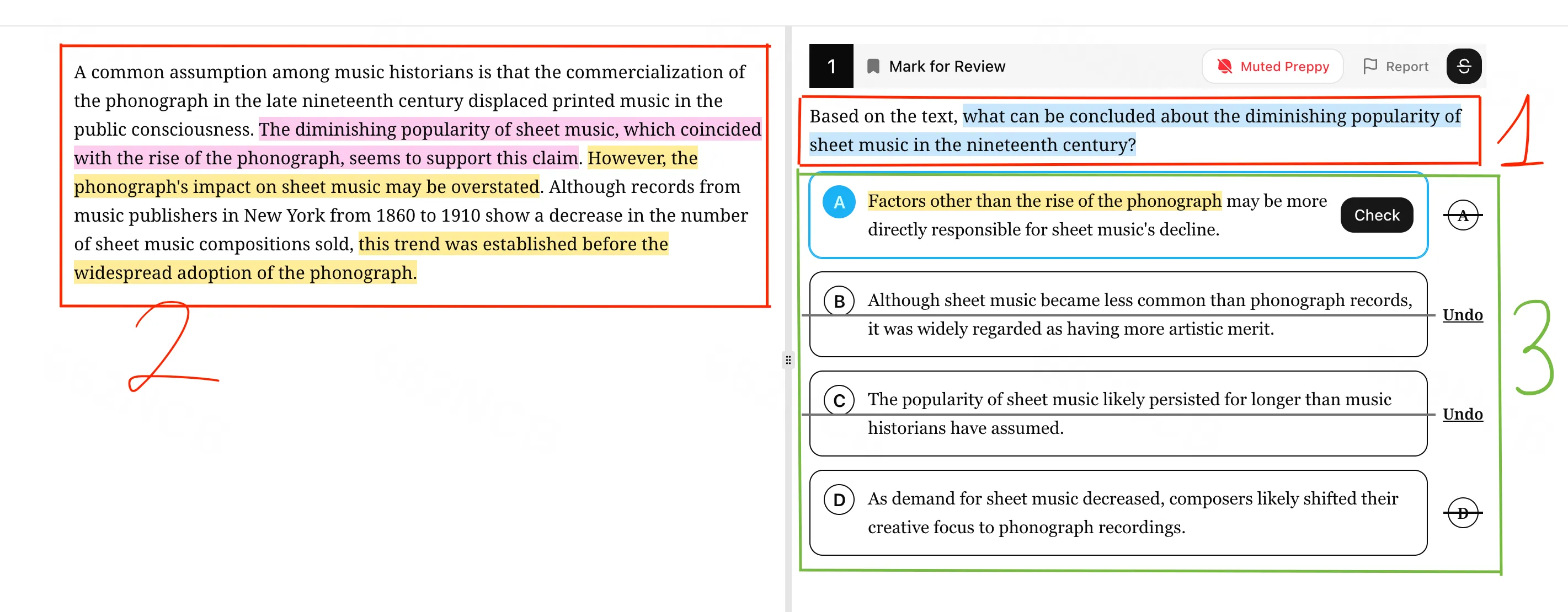
Here's the discipline: read the question, identify exactly what it's asking, locate the relevant part of the passage, form your own answer in one sentence, then look at the choices. The right answer will match your sentence. The wrong answers will be close but subtly off in a way you can immediately identify.
Students who read the answer choices first get pulled toward attractive distractors — options that sound plausible but aren't actually supported by the text. The moment you read a choice and think "that could work," you've started arguing for it rather than evaluating it. Avoid that trap entirely by committing to your own answer first.
Domain 1: Information & Ideas
This domain tests whether you can accurately understand and use information from a passage. Questions fall into three types.
Reading comprehension
These questions ask what the passage says, implies, or primarily discusses. They look like:
- "Which choice best states the main idea of the passage?"
- "According to the passage, what does X suggest about Y?"
- "Which choice most logically completes the text?"
The approach: Identify the specific sentence or sentences that answer the question. The correct answer will be a paraphrase of those sentences — not a word-for-word copy, but a restatement of the same idea. Wrong answers typically commit one of three errors: they go beyond what the passage says (too broad), they contradict the passage, or they focus on a detail rather than the main point.
Command of evidence — textual
These questions give you a claim and ask which quote from the passage best supports it. They look like:
- "Which quotation from the passage most effectively illustrates the claim that X?"
The approach: Read the claim carefully. You're looking for a quote that directly demonstrates — not merely relates to — that specific claim. Wrong answers are often quotes that are on the same topic but don't actually prove the stated claim. The test is very precise here: "illustrates" means shows, not just mentions.
Command of evidence — quantitative
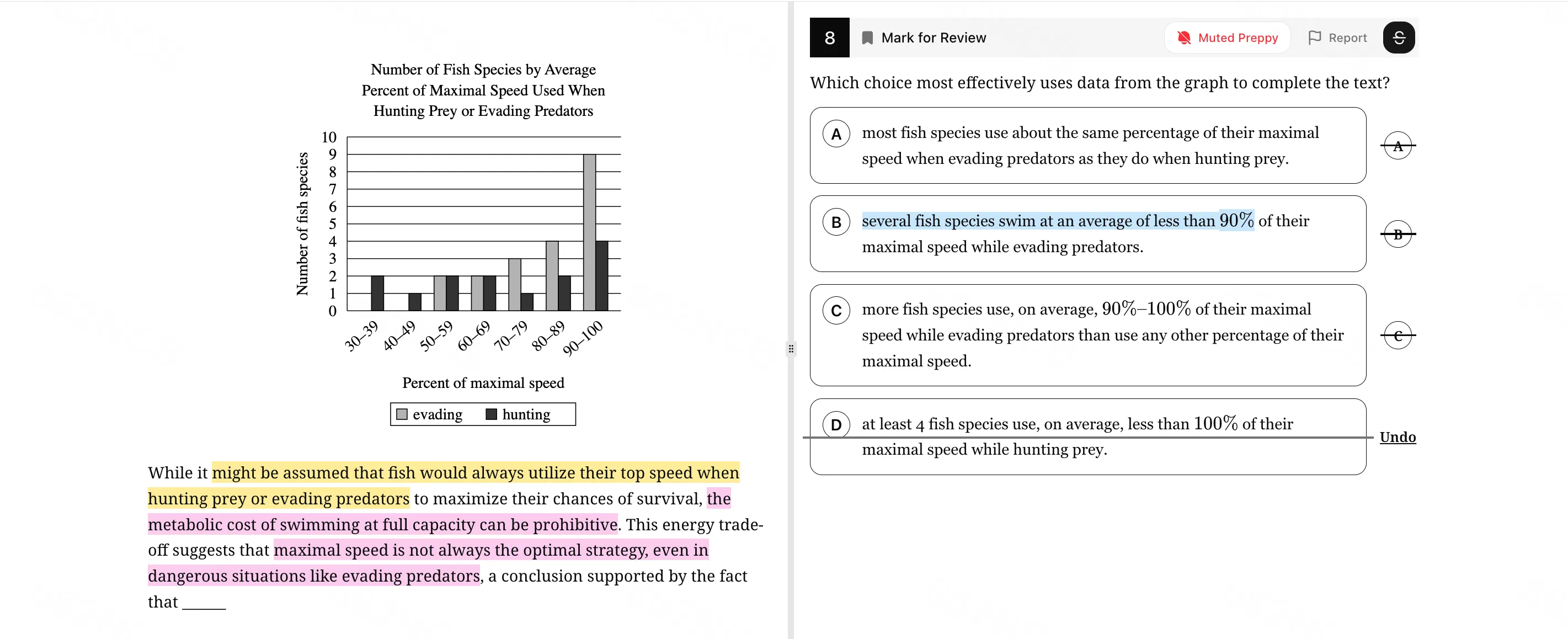
These questions pair a short passage with a graph, table, or chart and ask you to draw a conclusion that the data supports.
The approach: Read what the question is asking before looking at the data. Then find the specific cell, bar, or data point that answers it. The correct answer will be directly readable from the data — no calculation, no inference beyond what's shown. Wrong answers typically misread the data, confuse the axes, or make claims the data doesn't support.
Domain 2: Craft & Structure
This is the highest-weighted domain and the one that separates good scores from great scores. It tests whether you understand how and why a passage is written — not just what it says.
Words in context (vocabulary)
These questions ask you to identify the most appropriate word or phrase for a specific context. They look like:
- "As used in the passage, the word 'X' most nearly means..."
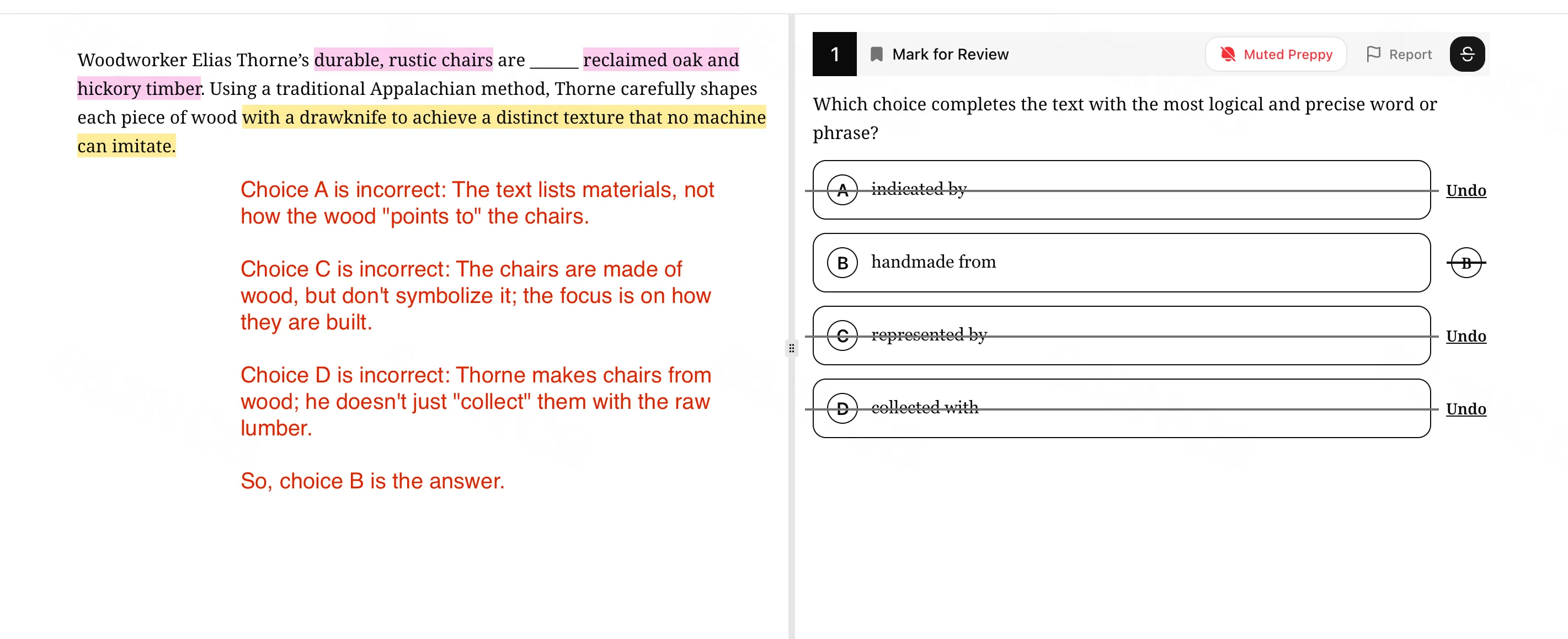
- "Which choice completes the text with the most logical and precise word or phrase?"
The approach: Cover the answer choices. Read the sentence with the blank. Ask: what does this sentence need — in terms of meaning, tone, and register? Then look at the choices and find the one that fits all three.
The most common mistake is selecting a word that is a common definition of the highlighted word but doesn't fit the specific context. "Grave" can mean a burial site, or it can mean serious/solemn. The passage context determines which meaning applies.
Words in context questions are not testing your vocabulary knowledge. They're testing your ability to use context as evidence. A student who knows every definition in the dictionary but ignores context will miss these. A student with a modest vocabulary who reads carefully will get them right.
Text structure and purpose
These questions ask why a passage is structured the way it is, or what rhetorical function a specific part of the passage serves. They look like:
- "What is the main purpose of the underlined sentence?"
- "Which choice best describes the overall structure of the text?"
- "The author mentions X primarily to..."
The approach: Think about what the sentence or paragraph is doing in the argument — not what it's saying, but what function it serves. Is it introducing a claim? Providing evidence? Acknowledging a counterargument? Transitioning to a new point? Drawing a conclusion?
Common answer choice language to know:
- "To illustrate" — providing an example
- "To contrast" — showing a difference
- "To qualify" — adding a nuance or limitation
- "To refute" — arguing against
- "To concede" — admitting a point while maintaining the overall argument
Match the function language in the answer choices to what the sentence is actually doing.
Cross-text connections
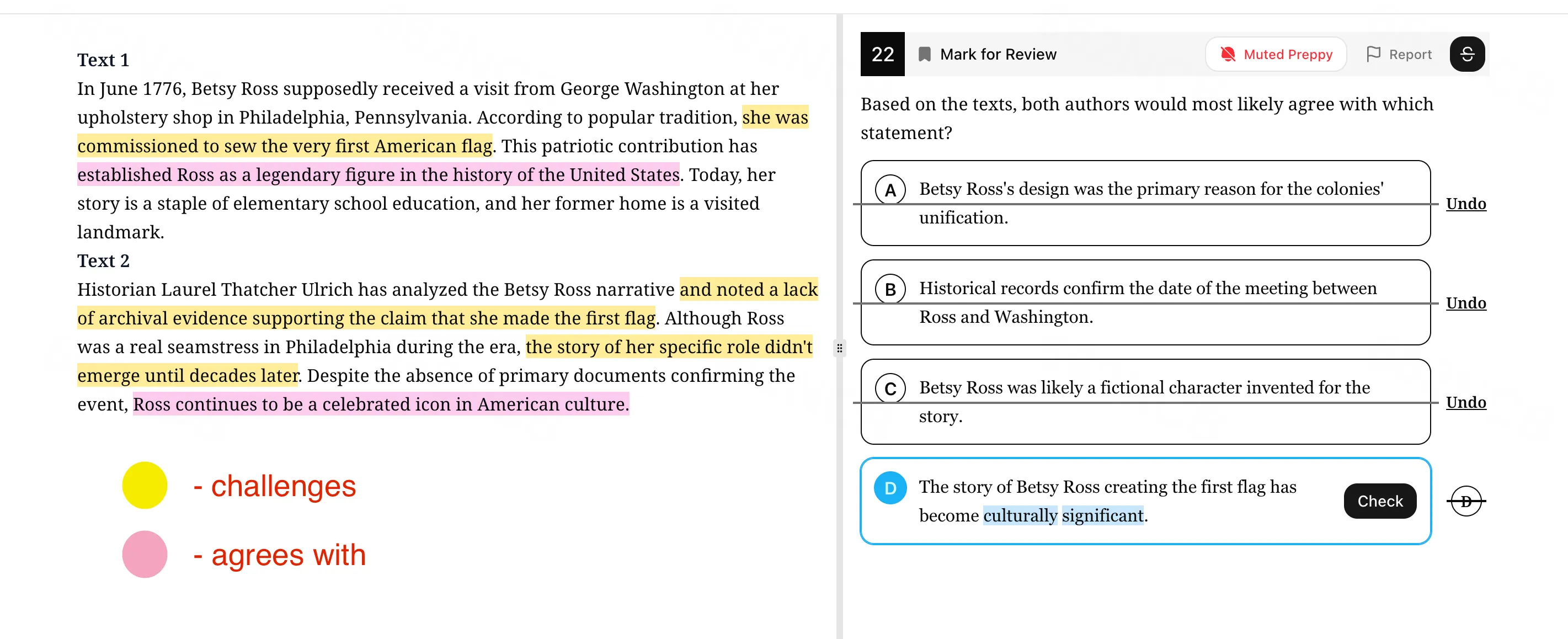
These questions are unique: they give you two short passages and ask you to compare them — identifying agreement, disagreement, or how one author would respond to the other.
The approach: Identify each author's main claim or position first, before reading the question. Then the question becomes: does Author 2 agree, disagree, or add nuance to Author 1's position? Wrong answers frequently mischaracterize one author's view or overstate the degree of agreement or disagreement.
Domain 3: Expression of Ideas
This domain tests writing craft — specifically, how to combine information effectively and how to connect ideas with the right transitions.
Rhetorical synthesis
These questions give you a set of notes or bullet points from a student's research and ask you to select the sentence that best achieves a stated goal using that information. They look like:
- "The student wants to introduce the topic to a general audience. Which choice most effectively uses the notes to accomplish this goal?"
The approach: Read the goal statement carefully — it's the most important part of the question. The goal will specify an audience, a purpose, or a rhetorical effect (e.g., "emphasize a contrast," "establish a problem," "support a claim with evidence"). Then evaluate each choice based purely on how well it achieves that goal. A choice that uses accurate information but misses the stated goal is wrong.
Common goals tested:
- Introduce a topic to a general audience (accessible, no jargon)
- Emphasize a similarity or difference between two things
- Support a claim using specific evidence from the notes
- Describe a cause-and-effect relationship
Transitions
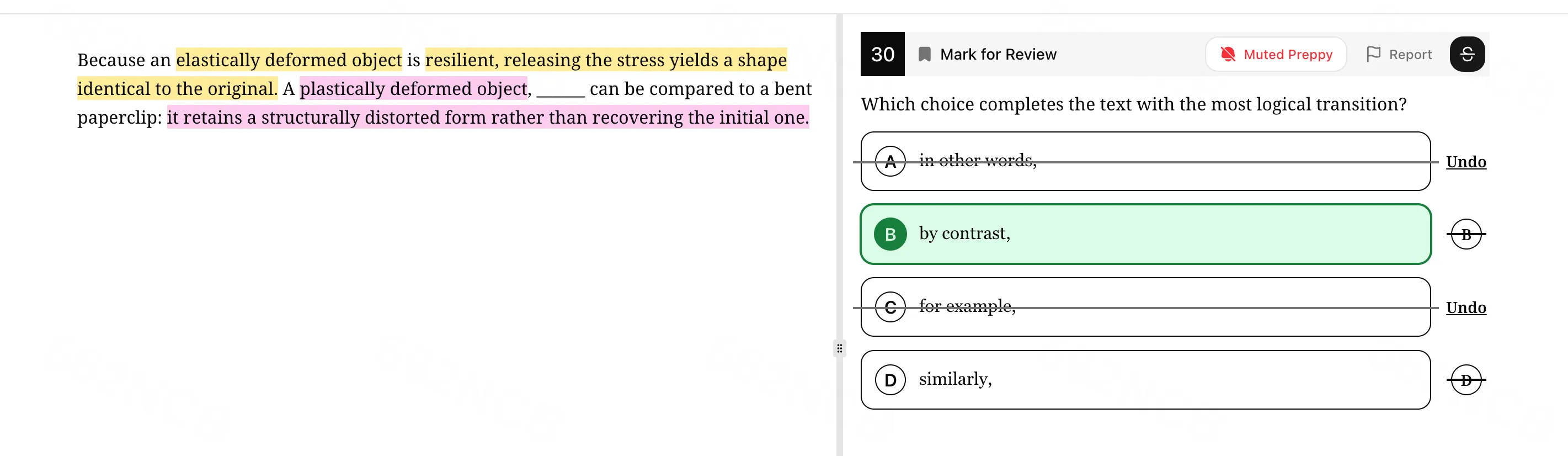
These questions ask you to select the most logical transition word or phrase between two sentences or ideas. They look like:
- "Which choice most logically completes the text?" (with options like "However," "Therefore," "For example," "Similarly")
The approach: Read both sentences and identify the logical relationship between them. Then match that relationship to the correct transition type:
| Relationship | Transition words |
|---|---|
| Contrast / contradiction | However, Nevertheless, In contrast, Yet, Although |
| Cause and effect | Therefore, Thus, As a result, Consequently |
| Addition | Furthermore, Moreover, In addition, Also |
| Example | For example, For instance, Specifically |
| Similarity | Similarly, Likewise, In the same way |
| Concession | Admittedly, Although, Even though |
The wrong answers will use transition words that signal the wrong relationship. "However" where "Therefore" belongs completely reverses the logic.
Domain 4: Standard English Conventions
This is the most mechanical domain — and for that reason, the highest ROI per hour studied. The rules don't change. Learn them once, apply them forever.
Punctuation
Punctuation questions are the most common grammar question type on the SAT. The rules tested are specific and finite.
Commas:
- Separate items in a list
- Set off non-essential (parenthetical) information — information the sentence still makes sense without
- Separate two independent clauses only when followed by a coordinating conjunction (FANBOYS: for, and, nor, but, or, yet, so)
- Do NOT separate a subject from its verb
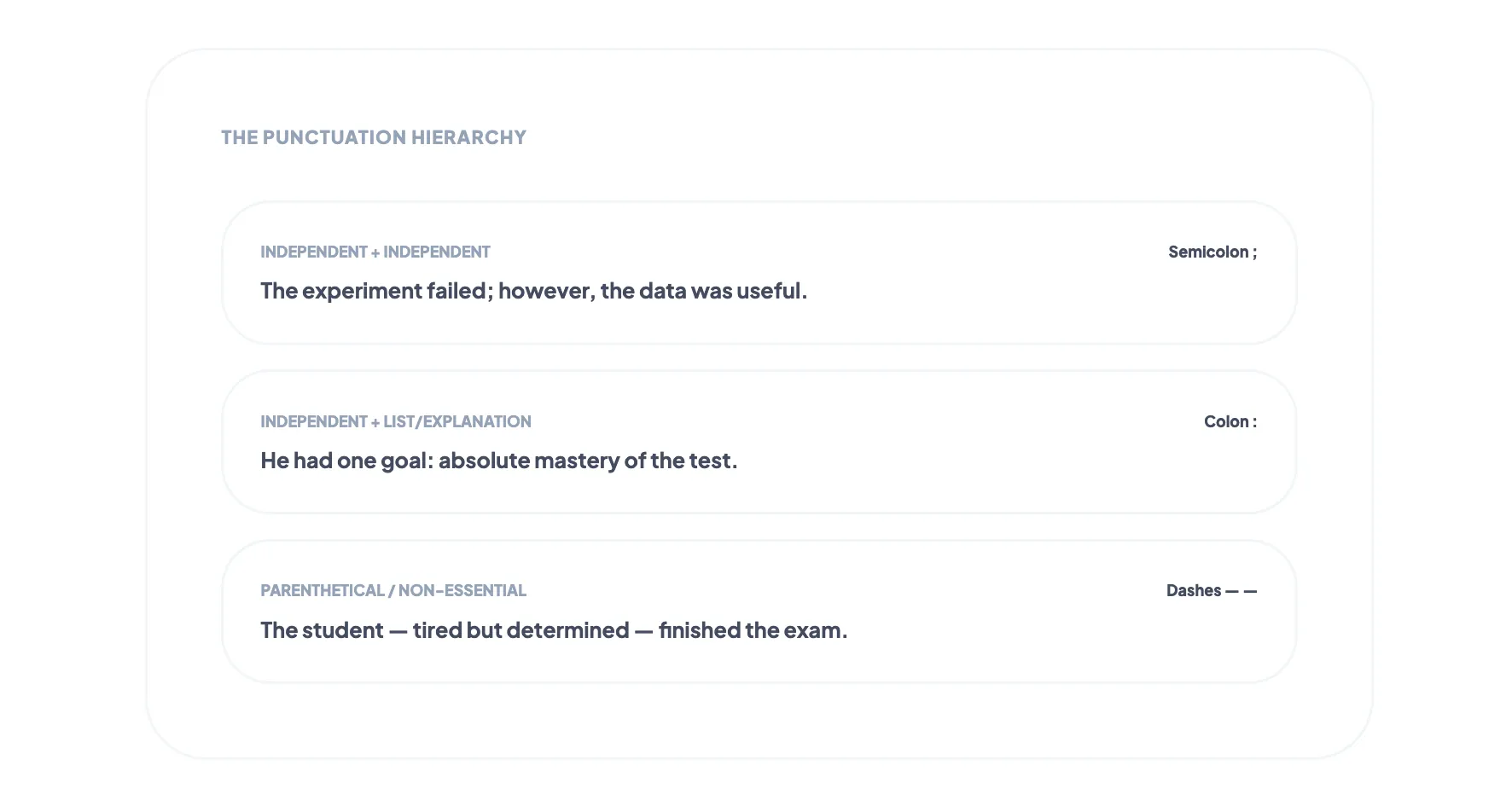
Semicolons:
- Connect two independent clauses without a conjunction
- The sentence on each side of the semicolon must be able to stand alone
Colons:
- Introduce a list, explanation, or elaboration
- What comes before the colon must be a complete sentence
Dashes:
- Set off non-essential information (like commas, but stronger emphasis)
- A pair of dashes sets off a parenthetical; a single dash introduces an explanation or elaboration
The non-essential clause rule is the most frequently tested punctuation concept. If you remove the underlined portion and the sentence still makes grammatical sense and retains its core meaning, the portion is non-essential and must be set off with commas, dashes, or parentheses — matching punctuation on both sides.
Sentence structure
These questions test whether a sentence is grammatically complete and correctly structured.
Independent vs. dependent clauses:
- An independent clause has a subject and verb and expresses a complete thought — it can stand alone
- A dependent clause has a subject and verb but does not express a complete thought — it cannot stand alone
- Two independent clauses joined without any punctuation or conjunction = a run-on sentence (wrong)
- A dependent clause standing alone = a sentence fragment (wrong)
Subject-verb agreement:
- The verb must agree with its subject in number (singular/plural)
- The SAT deliberately inserts long phrases between the subject and verb to obscure this relationship
- Technique: cross out everything between the subject and verb, then check agreement with what remains
Pronoun agreement:
- Pronouns must agree with their antecedent in number and gender
- "Everyone," "someone," "each," "neither" are singular — they take singular pronouns
Modifier placement:
- Modifying phrases must be placed immediately next to what they modify
- The SAT tests dangling modifiers: "Running through the park, the trees looked beautiful" — the trees weren't running
Verb tense and form
Verb tense questions check whether the tense used is consistent with the rest of the passage and logically appropriate for the time relationship described.
The most common errors:
- Switching tense mid-passage without reason
- Using past perfect (had done) vs. simple past (did) incorrectly
- Gerund vs. infinitive: "to run" vs. "running" — context determines which is correct
How to approach the section on test day
Read the blurb first
Every passage on the SAT has a short introductory blurb — one or two sentences identifying the source, author, and context. Most students skip it. Don't. The blurb tells you the author's purpose, the discipline (science, history, literature, social science), and often the tone. This context shapes how you evaluate every answer choice that follows.
Use process of elimination ruthlessly
On every question, eliminate before you select. Wrong answers on the SAT Reading & Writing section are wrong for specific, identifiable reasons:
- Too extreme — uses words like "always," "never," "proves," "definitively" when the passage is more cautious
- Out of scope — introduces information not mentioned in the passage
- Contradicts the passage — says the opposite of what the text states
- Too narrow — focuses on a detail when the question asks for the main idea
- Partially correct — the first half matches but the second half doesn't
Learning to identify why an answer is wrong — not just that it's wrong — makes elimination fast and reliable.
Never spend more than 90 seconds on one question
If you've been on a question for 90 seconds and you're still uncertain, flag it and move on. Come back with fresh eyes. This is especially important in Reading & Writing, where overthinking pulls you toward wrong answers. Your first instinct — if grounded in the text — is usually correct.
The Reading & Writing study plan
Week 1–2: Standard English Conventions Start here. It's the fastest domain to improve because the rules are fixed. Learn punctuation rules, subject-verb agreement, and modifier placement. Drill with untimed practice until each rule is automatic.
Week 3–4: Information & Ideas Practice the evidence-based approach on every question. Force yourself to locate the specific sentence before looking at choices. Do this until it's a reflex.
Week 5–6: Craft & Structure and Expression of Ideas These require more contextual reading. Practice identifying text structure, transition logic, and rhetorical purpose. Cross-text questions benefit from a consistent two-passage annotation approach.
Throughout: Error log After every practice set, record every wrong answer. Note the domain, the question type, and the reason you got it wrong (misread passage, ignored context, chose too extreme, etc.). Patterns will emerge within two weeks.
Daily practice makes the difference
The Reading & Writing section rewards students who read carefully and reason precisely under time pressure. That combination only comes from consistent, deliberate practice — not a weekend cram session.
LockedIn delivers daily SAT drills directly to your inbox, including Reading & Writing questions across all four domains, with instant feedback. Free, no tutor required, on your schedule.
Start for free at lockedin.study →
Quick reference: question types and approaches
| Domain | Question type | Core approach |
|---|---|---|
| Information & Ideas | Reading comprehension | Paraphrase relevant text, eliminate |
| Information & Ideas | Evidence — textual | Quote must directly prove the claim |
| Information & Ideas | Evidence — quantitative | Read data literally, no inference |
| Craft & Structure | Words in context | Use sentence context, ignore dictionary defaults |
| Craft & Structure | Text structure/purpose | Identify what the sentence is doing |
| Craft & Structure | Cross-text connections | Identify each author's claim first |
| Expression of Ideas | Rhetorical synthesis | Match the stated goal, not just accuracy |
| Expression of Ideas | Transitions | Identify the logical relationship first |
| Std. English Conventions | Punctuation | Learn the finite rule set cold |
| Std. English Conventions | Sentence structure | Check for fragments, run-ons, agreement |
| Std. English Conventions | Verb tense/form | Check consistency with surrounding context |
Related: How to study for the SAT effectively: the no-BS blueprint Related: SAT math prep: the only algebra guide you need Related: Digital SAT adaptive format explained: how to use it to your advantage
LockedIn is a nonprofit SAT prep platform — free forever, built for students who are serious about their score. Get started at lockedin.study.
Enjoyed the read?
Join 10,000+ students getting elite SAT drills every morning at 5:00 AM.